There comes a point when one has a dreaded lurgy, and it will differ for each person, when the thought of staying in bed one moment longer is just unbearable.
That moment was yesterday (Saturday) morning. The sky looked blueish enough, my cough was less hacky, and I thought, enough.
Rugged up well so I would not make my cough worse, I ventured outside, where I discovered my daffs and jonquils were in full bloom. I usually don’t pick them, because I love them in the garden, but there were so many I decided I could afford to fill a vase.
Saturday
My first job though was to dig over the chopped down green manure beds. Last week, I had hacked back the green manure and left the roots to release their nitrogen. This weekend, I dug them into the soil. I will leave them again for another week before digging them over again.
I was very pleased to note that when I dug over the bed near the chicken coop, I only found a small handful of roots and rocks. Last time I dug over that bed (in Autumn), I dug up a whole bucketful of horrible roots and rocks. I also noted that the soil right across the veggie patch is returning to a healthy state after my experiment with no-dig gardening went awry.
After digging these beds over, I sprinkled them with pelletised chicken manure and rock dust, and raked each one over.
Rock dust soil improver helps to remineralise the soil
Soils around the world, including Australia, have become progressively demineralised. While agricultural soils are the most impacted, home garden soils can also be affected. Rock dusts are a relatively, cheap, accessible, and organic method of improving the mineral content of the soil.
You can buy rock dusts from a range of sources, but I bought this bag from the Diggers Club when I ordered some seeds and plants recently. I do not apply rock dusts annually – I think I last applied some a couple of years ago. However as I am trying to repair my soil, I decided I would do it again this year.
It’s easy to apply. Just choose a clear day with little wind, mask up so you don’t breathe any in, and sprinkle it lightly on top of your soil. Instructions say a ‘handful per 1 metre square’ – however I have little tiny bird lady hands, so that doesn’t help me much. I just sprinkle what I think looks about right. Scientific!
Rake and water in. That’s it!
I also sprinkled a little on each potted fruit tree. I have four fruit trees in pots at the moment, including a new pink finger lime and a mini peach tree that I bought because it was so cute. I don’t even know what kind of peach it produces.
Then the rain came, and I headed inside so I would not get crook again.
Sunday
Sunday was supposed to be wet and horrid, according to the AI (Google Home), but my standard boring human intelligence informed me (by looking out the window) that the day had dawned clear and perfect. So out I went again, determined to spread sheep manure around my fruit trees, a job that I do every Winter. I am late to this task, preferring to do it in July rather than August, but better late than never.
You know you’re feeling better when you can spread sheep manure.
Every tree received a sprinkle of organic fruit tree fertiliser, a sprinkle of rock dust, a bag of sheep manure, and some mulch. What lucky trees!
I feel so dang virtuous!
You know what else I feel? Actually better – as in, well.
I honestly believe that spending time in the cool, fresh air and sunshine, surrounded by some healthy dirt and sheep poop, was the cure I needed.
How can I bottle that, I wonder? Maybe I should start a wellness Tik Tok. SheepPoopGirl? ManureMama?
When we first moved into our place about ten years ago, I knew I wanted to grow fruit trees. Our block is not ideally situated for this, in all honesty. It slopes awkwardly, and the front yard is North facing. The soil was very poor limestone. It was planted with eucalypts and palms, with weed matting throughout. The backyard was closely planted with huge conifers and agaves. We paid an arborist to remove the trees and my husband tackled the agaves, and with a blank slate, we planned the garden. Our goal was to have a mix of productive and sensory plants, with the intention to always have something edible to pick from the garden at any time, whether it be herbs, fruits or veggies.
A decade later, we have a large herb, sensory, and veggie garden on rich soil, and about twenty different fruiting trees. In the front garden, this includes a black mulberry tree, which was planted nine years ago.
I love mulberries, but you can’t buy them in the shops. I have fond memories of visiting my friend’s house in the Summer, climbing her huge mulberry tree and sitting up there and searching around, finding the little black jewels. I still like ferreting around the tree, searching around jewel-like fruits to find the black, ripe berries. They look like they belong in a fairy story.
Mulberries are not a commercially viable crop. Picking them takes ages, as the berries ripen at different times. You have to walk slowly around the tree to find the couple of berries per branch ready to pick. They don’t transport well, and the shelf life is not long. So if you want mulberries, you have to grow them. And they are an acquired taste. Not really sweet like commercial berries, mulberries are tart-sweet with an underlying metallic taste that some people do not enjoy.
However, they are hard won. I was not expecting to have much of a crop for the first couple of years, but in the past few years we have waited expectantly for fruit that never came. We have had a couple of dry, tasteless berries each season, then the birds have carried off the rest. Last season, I was despondent, then threatening. I told my husband, “That bloody tree has one more season to produce some fruit, or it’s gone!” Then I thought, as with many garden-related issues, maybe the problem isn’t the tree – maybe it’s the gardener.
It didn’t fill me with joy to admit it, believe me. I don’t want to accept that perhaps I had been neglecting the tree. After all, the apricot tree gave us a bumper crop last year. So did the lime tree. Clearly, I could get a tree to produce fruit. But just as different kids need different parenting techniques, so might different fruit trees. So, I read up on mulberry trees. Any info I could find on mulberries, I consumed. Of course, there were differing opinions. Some said prune. Some said don’t prune. But almost all the experts agreed mulberries needed two things in abundance.
Water and fertiliser. Not so revolutionary after all. Turns out, I had been underwatering and under-feeding the poor tree. I upped the water, which makes a lot of sense on our north-facing hillside (deep water, once a week), and increased the nutrition. From early Spring, I fed the tree with a couple of handfuls of organic fruit tree fertiliser every month around the base of the tree, watered in well.
Of course – and like all podcasts, there are good ones and…not so good ones.
When I’m out in the garden, I like to be joined by other gardening nerds, so I listen to gardening podcasts. My preference is for Australian podcasts of course, because the hosts know our unique growing conditions and the information is seasonally relevant. However, I do listen to one or two international pods, if I think I can use the information or I like the hosts and the content.
I have tried and tested almost all the different gardening podcasts out there, and these are my top five.
All The Dirt is an Aussie pod recorded in Western Australia, hosted by horticulturalists and garden writers Derryn Thorpe and Steve Wood. Almost every week they interview an Australian garden expert, horticulturalist, or gardening writer on a specific topic (for example, curator of the WA Seed Centre at Kings Park, or the Compostable Coach (aka Compostable Kate) about different methods of home composting). In other episodes they will just have a chat about best plants to grow in a Summer veggie patch (tbh these are my favourite episodes). I like their gentle, knowledgeable approach, that makes you feel like you are joining them for a cuppa and a scone.
This is an American gardening podcast, with two very different hosts from two very different parts of the USA. Ben gardens in the South, and Batavia gardens in metro Chicago. Their banter can take some getting used to (quite different from the more laidback Aussie style of All The Dirt, for example). At first I found Ben’s approach a bit abrasive. After sticking with it, I found that Batavia is more than able to handle him, and I enjoyed their divergent communication styles and gardening approaches, which are very different due to the different conditions they garden under. To deal with the seasonal differences, I generally listen to their Summer podcasts (current now) in our Summer (so, six months behind) and am now listening to their Winter gardening podcasts from last year. Or I choose podcasts that are not seasonally specific. For example, they did a great series on food security and preserving food, and another on sustainable gardening. Everything comes from the perspective of home gardeners.
Another Western Australian podcast, hosted by Amber Cunningham and well-known gardening expert Sabrina Hahn, this is one for people who don’t mind a laugh while learning about gardening. I’d say only about half of the pod is about gardening; the rest is jokes, Sab laughing at her own jokes, and general tomfoolery. Available through regular podcasting apps as well as the ABC Listen app.
The podcast of the Saturday morning ABC Adelaide’s talkback gardening show, hosted by Deb Tribe and gardening expert Jon Lamb, expect a million questions about lemon trees, citrus gall wasp, and how to remove scale from various trees. Regular helpful guests including interviews with local fruit tree nursery owners, a citrus expert, a turf consultant, some rare fruit and organic gardening experts, houseplant, garlic, and herb writers, and a monthly long range weather forecaster who gives his very accurate predictions about the weather and rainfall at the start of each month. As comfortable as a well-worn gumboot. Available through regular podcasting apps as well as the ABC Listen app.
A recent discovery, Avant Gardeners is a Tasmanian podcast hosted by two women, Emily and Maddie, who are a bit like me – raising families, trying to fit gardening in their busy lives, doing their best. They also interview gardening experts, in a similar vein to All The Dirt, but as the hosts don’t have the decades of industry expertise, it’s quite charming and chilled. I’d have to describe it as very ‘Tassie’? There is a distinct difference that you can feel between the WA and Tassie gardening podcasts – I reckon it’s all that lovely water and cool weather in Tasmania. They’re just not that worried about as much in the garden, whereas the WA gardeners seem just a bit stressed out all the time. I get it – trying to grow a garden on pure sand with almost no water will do that to a body.
What to do in the garden with the time you have this week
If you have an hour
Check your garden for slugs, snails, and cabbage moth larvae. The wetter weather attracts these pests, so I often take a walk around the patch to check for them and pick them off the brassicas. My chooks don’t eat them (little slackers), so I usually squish them. Although I don’t use poisons in my garden, I do sprinkle an organic iron-based pellet around the leafy greens and brassicas to deter slugs and snails (non-toxic to dogs and cats and other furry critters). A visit from these little monsters can take out your Winter veggie patch overnight!
If you have 2-3 hours
Start trimming dead growth on woody herbs. Ideally, I would have done most of this in late Autumn, but pobody’s nerfect, amiright? My herb garden is large, and trimming all the old woody growth on the mint, oregano, salvia and thyme takes a long time. I spent several hours on this extremely boring task last weekend, and only completed about 30% of the task. I have it on my list for this coming weekend as well (reluctantly). I know that future me will be very pleased with past me if I do get this task done, as future me will be rewarded with lush new growth in Spring.
If you have 5-6 hours
Mulch all your fruit trees with aged cow or sheep manure. I do this every Winter. As I have about twenty fruit trees, it takes me a long time. This is another one of those boring, once-a-year tasks that I don’t really enjoy, but I know must be done. The thick mulch of manure creates a warm blanket over the soil and rots slowly. By Springtime, the nutrients are ready for the tree to take up in time for the fruiting season.
My preference is to use aged sheep manure, but my usual supplier sold out this year, so I settled for cow manure. Either will do the job, but I do prefer aged sheep manure because it is higher in potassium. Just make sure that whichever poo you choose, it is well aged and composted, and that when spreading you do not place it right up to the tree trunk – leave a ring of 5-10 cm away from the trunk to prevent collar rot. Then let it rot down slowly over Winter and into Spring. I use three 25 litre bags per large tree (e.g. the Apricot and Mulberry trees), and one 25 litre bag per small tree (e.g. the dwarf Apples and Plums).
We spent a few days in Sydney last week, in perfect weather. Aside from the usual things (Opera House, Harbour Bridge, ferry rides), we visited the Botanic Gardens, which had a beautiful rainforest section and a fernery.
The fernery was stunning. We learned a lot about how ferns reproduce, and the variety of ferns in Australia. I recommend a visit if you ever visit Sydney.
We also took a ferry ride to the ritzy suburb of Rose Bay. The reason we went there, aside from the fun ferry ride, was that it has a beautiful, bay with crystal clear water, and art deco buildings in pristine condition. It has streets lined with enormous trees – really gorgeous and worth the trip.
Greenhouse Jobs
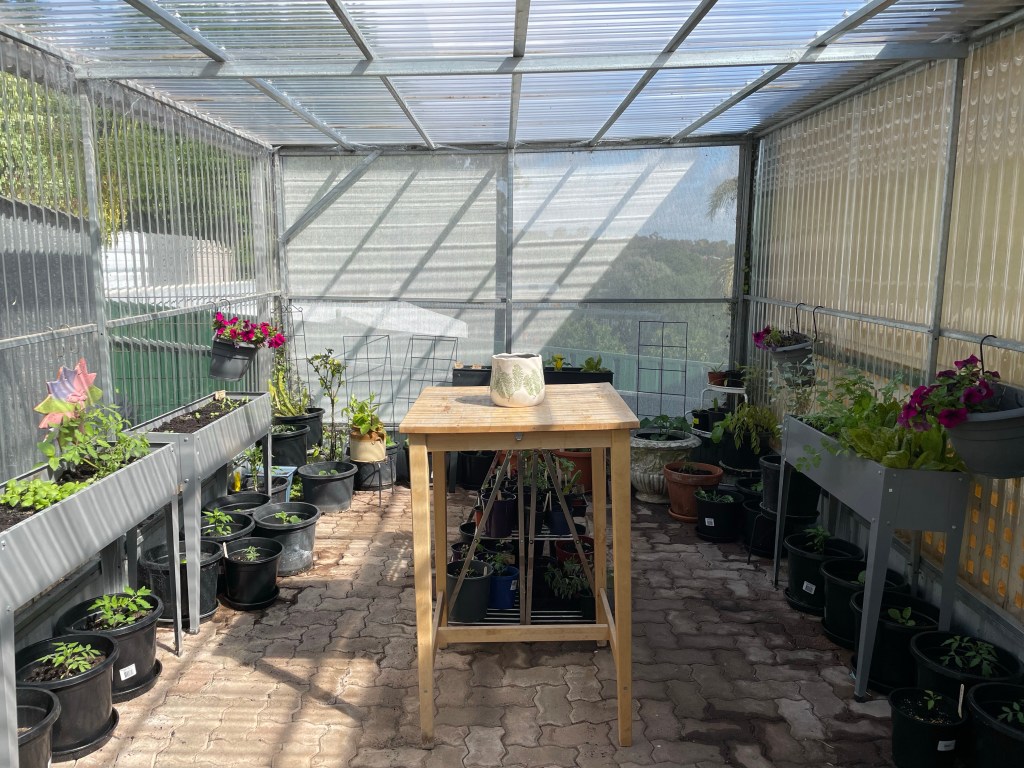
I spent several hours rearranging my greenhouse this morning. My husband suggested making better use of the space by shifting some shelving to the centre of the greenhouse. This was a really smart idea, and it also gave me the opportunity to clear out some cobwebs, creeping oxalis that had wormed its way in, and sweep out the greenhouse. Once I did that, I moved a heap of pots around, moved the shelving racks to the centre, and then had the fun of potting up a lot of seedlings that were ready to move from the seed troughs.
Rearranged Greenhouse
Mulching and weeding
Due to the combo of warm, sunny weather last week followed by cool rainy weather this week, the weeds have come out in full force. I have spent quite a lot of time trawling around the garden, bucket in hand, pulling out weeds. These were much worse in the front yard than the back, where I do admit to spending more of my time. Some kind of grass has found its way into the front garden, probably blown in, and I have finally given it my attention. Fortunately it was easy to yank up, but it really was all over the place.
Another job I have put off in the front yard was mulching (the back yard veggie patch has been properly mulched for several weeks now, in anticipation of the warmer weather). In the backyard I use a straw mulch (lucerne or sugar cane), but in the front yard I use a cottage mulch because it is more attractive. I finally started it today, and realised I really underestimated how much mulch I needed for this job!
Mulberry answers?
As I mulched and weeded, I listened to Roots and Shoots, an ABC gardening podcast from Western Australia. I also listen to the local Talkback Gardening podcast from here in South Australia, but when I have finished these, I turn to Sabrina in WA. Someone called in asking how often to water a mulberry tree during Spring. My mulberry tree is a current bane of my garden (you should see our back neighbour’s tree – covered in ripening mulberries! Our tree – tiny green fruits!). Sabrina said mulberry trees should be watered twice a week in Spring and three times a week in Summer. I water about half as often as she recommended – this could be the answer to my mulberry tree woes. I immediately put the hose on the mulberry tree.
Quinces and plums
It’s not all woe in my garden though! The plum trees we planted last year have tiny plums, the lime tree is covered in tiny limes once more, (after an absolute bumper crop last year), the apricot tree is loaded, and the quince tree we just planted six weeks ago is covered in blossom!
Some people would recommend trimming blossom off a newly planted tree to let it put all its energy into growth. I just let the tree do its thing. That may not be the right approach, but it’s what I do.
The apple trees are also both covered in blossom, and we are hoping for a good crop this year.
On the other hand, I had to dig up the ring-barked passionfruit, leaving just one sad passionfruit left of the five I planted two years ago. I have two tiny Red Flamenco passionfruit growing from seed, still alive in the greenhouse. If these don’t make it, I might wave a white flag on passionfruit. It feels almost unAustralian, saying that.
What to do in the garden with the time you have this week
If, like me, you have minimal time, here’s some suggestions for what to do with it:
If you have an hour
Plant some zucchini and pumpkins. The soil has warmed up now (although it’s cold in our area today) – push some zucchini, pumpkin, or squash seeds direct where you want them to grow and wait. They will pop their heads up soon! I’m finding all the extra spots in the garden to poke a few pumpkin seeds, including the front yard.
If you have 2-3 hours
Keep mulching. I don’t know about you, but mulching takes me a long time (I’m not as young as I used to be, and my yards are big). I spent a couple hours on it a few weeks ago, and a couple hours today. I’m still not done. I hope to have finished all the mulching by the end of October, before the really hot weather hits.
If you have 4-5 hours
Start planning for Christmas. When I look at my garden now, I’m thinking about how it will look in eight weeks’ time. We often host, and I like the garden to look nice. Do I want plants to be in flower? It’s going to be a hot Summer, so everything will be a bit droopy unless I make sure to mulch and water well now and in the future. What about colour? If I want to have a display of flowers by Christmas I need to start planning for that now.
It’s been another month of working almost every weekend, which has meant very little time in the garden. That’s rough at this time of year, when every day seems to call out to me to spend time in the veggie patch.
This weekend, for my sanity and for the sake of my garden, I closed the computer and stepped out into the sunshine. It was lovely.
Also, very needed. The veggie patch was a bit of a mess, frankly. I had been quickly chopping off the broccoli heads when they were ready, and leaving the plants to produce side shoots, but they were also done. The garden was half full of spent broccoli plants and kale bolting to seed. The kale was a variety I bought in Tasmania at the start of the year, and it did not like our warmer Winter – the leaves were almost leathery, and we did not eat much of it. I’ll stick to the Mediterranean kales like Cavolo Nero next season.
After cleaning out the chicken coop, I pulled out all the spent plants and dug over the beds. Just that one task made the whole patch look so much better.
After digging over, I mulched with pea straw. I planted out the first eggplant of the season (Slim Jim – heirloom), and some cool pumpkins called Wrinkled Butternut.
The Obelisk (not the Asterix)
On a whim last week I bought a finial, which I used to build an obelisk. A finial is a funky cast iron topper used to build a frame (the obelisk, kinda) for climbing plants – in this case, it will be climbing beans. My husband drilled it all together for me, and I installed it and expertly tied the twine 🙂
Behind it is another trellis. Beans will grow up that as well. This year I have planted Violet Queen, Kentucky Wonder, and Scarlet Runner. I have decided that this year I will pick many a bean.
The Greenhouse
I spent a few hours pricking out tomatoes and tomatillos from the seed troughs and into pots, to harden off ready for the garden. I haven’t grown tomatillos for well over a decade. My memory is they grow like the clappers, but hindsight can be 20/20. We will see how they grow in this veggie patch. Tomatillos, or husk tomatoes, make delicious salsa when roasted.
I also planted up yet more chillies. If all the chillies come off this year, we will be swimming in them. I already have 13 in pots in the greenhouse, and dozens coming on in the seed troughs. My plan this year is to make as much chilli pickle as I can, so there is method in my madness. Mwahahahahahaha.
What to do in the garden with the time you have this week
If, like me, you have minimal time, here’s some suggestions for what to do with it:
If you have an hour: feed your fruit trees!
They are awake now after their Winter dormancy, and like us when we wake up, they want food. Give all your fruit trees some specialist organic fruit tree fertiliser, and water in well.
If you have 2-3 hours: mulch!
This season is expected to be one of the hottest and driest Springs ever. The best thing you can do if you have some spare time in the garden is mulch the soil and retain the moisture of the Winter weather, before it heats up. I like sugar cane mulch, as it’s sustainable and breaks down slowly, but use any mulch you prefer. Just do it.
If you have 4-5 hours: feed everything, and start planting!
All plants need a feed at this time of year. I use organic liquid fertiliser, diluted well if the plants are seedlings, and stronger if the plants are established. Everything is hungry and wants a feed right now, so if you have time, wander around with your watering can and feed it all. Your plants will thank you. It takes time though! I’m always amazed at how long feeding all my plant babies can take.
I’m also trying to take advantage of the warm Spring weather to plant as much as I can right now. With the soil warming up and the longer sunny days, now is the time to plant fast-growing Spring crops, flowers, and start seeds for Summer. I have basil, cucumbers, tomatoes, beans, eggplant, capsicum, eggplant, chillies, tomatoes, watermelons, squash, and multiple types of pumpkin and zucchini in the greenhouse and the garden. As each plant is large enough to be potted on, new seeds take their place. And if you don’t have time, space, or interest to grow seeds, plant seedlings. Get the plants established before the really hot weather hits.
Apples x 2 (Cox’s Orange Pippin and Early Macintosh)
Blood Orange
Cumquat (Calamondin Green)
Blueberries x 2
Passionfruit (Nelly Kelly)
Pepino
We are also about to plant and espalier a quince (Smyrna) and our local council is also giving us a nectarine tree through their Adopt-a-fruit-tree program, soon bringing the total up to 19 fruiting trees. That should give you an indication, really, of just how much space we are fortunate to have in our yard.
You’d think with that many fruit trees, we’d be drowning in fruit all year round. Sometimes, we are. Right now, we have so, so many limes. I’ve given them away to friends and family (I offered them to a friend the other day and she politely declined – clearly, we have given her too many!). I’ve made just about every possible variation of lime pickle, jam, and chutney that it’s possible for one family to make. I’m out of ideas. We are limed out. In Summer, we had the biggest crop of apricots ever. Same deal. We still have them in the freezer. I also still have pomegranates in the fridge from Autumn as we slowly work our way through them (we have five littlies left).
Yet, for other trees, like the mulberry and apple trees, that much fruit is just a dream. Either the fruit is minimal at best, or the possums have crunched it up before we get to it. If we ever get an avocado, you will never stop hearing about it. I’ll brag about it for the rest of my life.
The fact is, growing fruit trees is a labour of love, and sometimes just a labour.
My goal in planting all these trees was to one day, never have to buy fruit again. Now I know that dream is a crock. Right now, I could eat only limes, but I think my family would object greatly to that. The fact is, I cannot really control the amount of fruit the trees will produce, as so many factors influence this, with weather being the main factor.
That doesn’t mean that growing fruit at home is not worth doing. Homegrown apricots are glorious. Homegrown limes are juicier and tastier than anything you can buy. Pomegranates cost five bucks each! I never buy them, but when I have them from my tree in May, I can decadently toss the juicy red arils on top of every curry or a tagine like the Sultan of Brunei.
Planning your fruit orchard
Before planting anything, consider your space and aspect. Fruit trees need space for their roots to spread. They also need full sun, ideally all day, but at least four hours daily. If you want to grow an orange tree and only have a shady corner of the garden, consider growing something else, or plant it in a large tub that can be placed in a sunny spot.
Speaking of tubs and pots, some fruit trees can be planted in tubs quite successfully, while others will struggle. Our lime tree was miserable and constantly attacked by scale when in a pot. When we moved it to the garden, it doubled in size and has not stopped fruiting since. However, our blueberry bushes and cumquat seem to be fine in pots.
Consider too, what you actually like eating. I enjoy growing fruits that are not easy to buy at the supermarket and that I can use to make jam and sauces. My husband likes to grow fruit he can eat fresh from the tree. We have compromised, and that is why we have the mix of trees we have. The pomegranate, cumquat, blood orange, lime, and pepino are for my fun experiments. The others are for fresh eating and also some for jam if we have any left over. However, if we had a smaller space, some of the more unique trees would not be in our garden. Fortunately, we have the space to include a wide range for our interests and tastes. If I was more limited in my options, the ‘no brainers’ would be an apricot, a lime or lemon, and a passionfruit vine.
Don’t forget, if you are limited on space, you can always grow up. We have five trees growing on trellises, by espaliering them. This has allowed us to grow many more trees than we could have if we had let them grow out instead of up. We have learned to do this by watching YouTube and visiting Botanic Gardens with espaliered trees. It’s not the cheapest way to do it (you have to buy posts, wires, hooks, etc), and it takes patience and practice. But it is an option if you have limited space, and can invest some dollars (about $50 per trellis).
Planting fruit trees
The old adage is that you plant a ten dollar tree in a hundred dollar hole. That means you should spend more time and money on preparing the soil than you spend on the tree itself. Most trees will thrive when grown in soil prepared with good quality compost, well-rotted sheep manure, and a side dressing of an organic fertiliser once planted. This doesn’t mean putting fertiliser in the hole when you plant. Prepare the soil with compost and manure a week or so before digging the hole.
On planting day, dig a hole twice as wide and deep as the root ball.
Make sure to tease out the roots so you are not planting roots that are tightly bound up. I like to soak the roots in a bucket of diluted seaweed extract for an hour or so before I plant. Then I put the plant in the hole, and pour the bucket of seaweed extract over the root ball and into the hole. I let it soak in, then back fill. Water in well. This gives the plant a good head start.
If you are mulching, make sure not to place the mulch right up to the trunk, as this can cause collar rot. Leave about five centimetres (2 inches) of free space around the trunk.
Some trees require special attention when planting. For example, an avocado tree should be planted on a mound with several bags of compost, then surrounded by a shade barrier to keep out wind and sun while establishing. Avocado trees are very sensitive to sun and wind burn, so taking the time to build a shade barrier will be worth your while, especially as avocado trees can cost upwards of $100. Check with your nursery for special instructions when buying your tree.
Now is the time to plant deciduous fruit trees (think apples, pears, plums, quinces, apricots, etc). I have a quince waiting to plant next weekend.
Caring for your orchard
Feed your trees! You won’t get fruit if you only give them a handful of Dynamic Lifter once a year. Fruiting trees are hungry plants, because they put a lot of energy into producing fruit.
At this time of year (mid-Winter), I give each tree a bag of pulverised, aged sheep manure. This rots down slowly over the season.
Then once Spring hits, my aim is to feed each tree with roughly two cups of Dynamic Lifter and blood and bone (combined) every month, until the end of fruiting season. That’s my goal but tbh, I am a bit hit and miss with it.
I also side dress each tree with compost progressively as I dig it out of my bins. Today the lime tree, blood orange, avocado, and both apple trees got the compost. I’ll keep working my way around the garden until each fruit tree gets a bucket or two of compost in the lead up to Spring. The compost is made of a mix of my chickens’ composted manure and litter, garden weeds, kitchen scraps, and occasionally a bag of my neighbour’s pigeon manure (pure gold). It’s very well composted down over several months and the trees love it.
And don’t forget to prune. We prune Summer fruiting trees (i.e. apricots, mulberries) after fruiting (late Summer/early Autumn), and then give them a light pruning to shape in Winter. The goal for trees like our apricot and mulberry tree is to create a lovely vase shape that will let light into the tree, and to prevent it growing too large.
This year we also lightly pruned our pomegranate for the first time, to remove some of the excess growth at the base, and the lime tree for the same reason.
Caring for fruit trees takes time and thought. We do it partly because the flavour of fresh, homegrown fruit cannot be beat, and because it’s fun. I also enjoy looking out of my office window and watching the rainbow lorikeets playing in the trees (even though I know they will steal the apricots as soon as they can).