Late Summer Gardening

February is a strange time in Southern Australia. It’s usually the hottest month, with many of the summer veggies such as beans and cucumbers almost at their end, but at the same time, it is usually too late to sow any new Summer plants. This year however, the late start to the season has the tomatoes, capsicums, eggplant, and chillies just kicking off. We are stuffing ourselves with fresh tomatoes in salads, salsas, on toast, and in pasta every day, and eating delicious fajitas with homegrown zucchini, drizzled with salsa made of tomatillos, green zebra tomatoes and jalapenos, pulled out of the garden that morning. It’s bliss – everything I have ever wanted in a garden.

To keep the Summer abundance going, I’m risking some late plantings with the hope of a longer season. I’ve planted more cucumbers, taking care to choose varieties that can apparently resist the powdery mildew (Jefferson’s Cucumber and Dragon’s Egg). I’ve planted a heap of dwarf beans (Dior bush beans) all over the garden in spots where I could poke a seed, with the hope of a quick extra bean harvest, if I’m lucky. We have eaten so many green beans this year, it has been fantastic.

I’ve raised some extra squash and zucchini plants, hoping we can get a couple of rounds of extra zuccs, as they are just my favourite veggies along with eggplant, and I live in hope. I’ve even taken a punt and planted some more tomato seeds – I have a greenhouse, so I think I can get another full tomato harvest before Winter sets in. I’m trialling late plantings of cherry and saucing tomatoes (Black Cherry, San Marzano).

Preparing for the Winter garden

Oddly at the same time I have just planted another round of tomatoes, I’ve also started planting brassicas for Winter. I have never grown Brussels Sprouts. I’ve always believed that our area is too warm for them to be successful. That might still be the case – but I recently read an article about growing them and decided to have a go. Brussels Sprouts must be started in February for success, as they need a long growing season, so today when planting my extra tomatoes I planted the first batch of Catskills Brussels Sprouts seeds. Hopefully they pop up soon and I can put another round in. If I succeed in growing Brussels Sprouts, I will be bragging so hard.

Catskills Brussels Sprouts

I also planted more Cos lettuce and dill seeds. I have recently discovered the wonder of fresh dill, and now all our salads are sprinkled with fresh dill and basil. My kids aren’t really fans of it, so I have to soften the dilly approach a little.

Some Summer garden duds

There have been some duds though, I’m not gonna lie. The Red Ruffle Eggplant have been a huge disappointment, and so have the Turkish Red Eggplant – in fact, eggplant in general have not responded well to the cool, wet start to the season. I have picked enough for one meal so far – definitely not the eggplanty-dreams I was hoping for. A batch of Armenian Striped Cucumbers fell prey to powdery mildew as soon as I planted them, without even offering a single cuke. Once again, melons have been a disappointment – why, oh why, do I keep planting them? And I have been battling the little jerk Red Spider Mite in the greenhouse for half the season. A mild soap spray seems to be doing the trick, but I have to be on top of it constantly.

Bye-bye Pepino

Speaking of garden duds, about two years ago I bought a pepino plant from the Big Green Shed and put it in the patch against the fence. To say it grew prolifically would be an understatement. That thing quadrupled, then quadrupled again. It saw off several passionfruit that came only to say hello, then gently expired. It flowered, and flowered, yet only bore mature orange fruit a handful of times. The fruit did not really appeal that much to anyone, tasting like a weird mini rockmelon. And still it grew. By mid-January this year, it took up a square metre of back garden space. And that is when I decided its number was up. That much garden space is far too precious to be taken up by a freeloading plant that no-one likes.

I think it took me well over an hour and a thousand calories to dig the thing up, but it has now been removed to the green bin where it belongs, and several squash and zucchini plants are sunning themselves in its place.

Good riddance.

This is a lesson to me not to be suckered in by something promoted by a garden centre, and to do a bit of research before planting something in my edible garden. I should have read up about how large the pepino grows, and what it tastes like. If I had just googled ‘what does a pepino taste like’ the first result would have informed me that it is ‘a delicate combination of cantaloupe and honeydew melon.’ I dislike both of those flavours, and so does my family. So, note to self: check these things.

But if you have plenty of space and you love melon, I can recommend a fast-growing bush apparently known as the “Year-Round Rockmelon”!

What to do in the garden with the time you have this week

Houseplants need attention this time of year. During Summer, houseplants are in growth mode, and are also prone to drying out in the warmer weather. Indoor houseplant gardening is still gardening, and requires focused attention to keep things looking good – in fact I would argue it requires more care and attention, because a dodgy looking houseplant is more annoying on a daily basis than a dodgy looking zucchini plant.

If you have an hour

Take cuttings and propagate in water. The warm weather is ideal for propagating houseplant cuttings. This weekend I took cuttings of Harlequin (Marble Queen) Devil’s Ivy (a gorgeous variegated Pothos with lovely marbled leaves), Scindapsus Golden Queen, and Dragon’s Tail (Epipremnum Pinnatum), and have placed them all in water to strike. I was careful to take the cuttings under a node where the plant will easily sprout a root. These plants strike very quickly just in water.

If you have 2-3 hours

Clean, water, trim, and feed your houseplants. Houseplants should be cleaned regularly, as the leaves collect dust, which prevents transpiration. In a tub of tepid water, add a drop of olive oil. With a soft cloth or paper towel, dip in the water and olive oil and wring out and clean the leaves of dust. The olive oil will give a gentle shine.

Using scissors or snips, remove dead or bedraggled looking leaves. Feed the plants with either slow-release prills such as Osmocote (my preferred) or Thrive for pots or planters, or a liquid feed for pot plants (I use the Powerfeed spray for indoor plants), and water your plants.

Depending on the number of plants you have, this task can take a couple of hours, by the time you clean, trim, water, and feed everything. I have quite a few plants, including hanging plants, so it generally takes me about two hours to complete, every couple of months. I know it is time to do it when my favourite houseplant, the beautiful giant Diffenbachia Reflector in my bedroom loses its lustre and bright neon and green colouring.

My huge spotted Begonia was also looking peaky, so I placed it in a bucket in the laundry and soaked it overnight in a tub of water. I find this treatment, once every six weeks or so, keeps it happy.

If you have 4-5 hours

Around this time of year, you will find some of your houseplants need re-potting. I have been looking at my houseplants since Christmas (and ignoring them), fully aware that about ten of them needed repotting. These included my Fiddle-Leaf Fig, Harlequin Pothos, a Silver Sword Philodendron (philodendrum hastatum) that was looking about as miserable as it was possible to look, and a floppy Monstera.

Repotting is easy but messy, so do it outside. Fill a bucket with water and some seaweed extract. Remove the plants from their existing pots, and soak them, soil and all, in the bucket. I was shocked to see how dried out some of them were. Let the plants soak for fifteen minutes, or until the water has penetrated the soil and roots. While it is soaking, give the plant a trim of dodgy looking leaves, and if you want to, take a cutting or two to propagate into new plants. I find that most houseplants can be easily propagated in either water or in sand or seed-raising mix. The easiest plants to propagate in my experience are pothos (Devil’s Ivy), spider plants, and spotted begonia (in fact these last two are so easy that I have had to stop propagating because I have too many).

Meanwhile, take new or recycled plastic pots in the next size up, and half fill with fresh potting mix.

When the plant has had a lovely soak and are wet all the way through, tease the root ball out a bit – not too much – and place it in the new pot. It’s ok if some of the existing soil comes along for the ride. Backfill with new potting mix and add a tablespoon or so of slow-release fertiliser for pot plants. Place the plastic pot in a cover pot, and water.

Remember that when you increase the size of the plastic pot, the cover pot you were using may no longer fit your plant. You may have to do some moving around.

Wash the old pots well with water mixed with a splash of methylated spirits or rubbing alcohol to clean properly, so you have pots for next time. Then clean up all that mess!

Again, the time this task will take depends on the number of plants you have to repot and the mess you make. I’m notorious for making a big mess (I figure, make a mess, apologise later), so I usually have a pile of old dirt, pots, and junk to clean up afterwards. But that is half the fun. Compost the old potting mix, recycle the pots, and try to waste as little as possible.

You can move your newly potted plants directly indoors, or if you want to you can also put them in a sheltered position to acclimate to their new pots. I tend to immediately place them where I intend them to live.

Gardening jobs, late Summer 2022

Pumpkin hanging on a trellis

After a relatively cool Summer (for Southern Australia), and a sudden burst of torrential rain caused by a tropical cyclone up North, we have had a spell of hot, humid days. This is not weather I enjoy. I love the heat, but I don’t love humidity. The constant blanket of moisture in the air feels oppressive to me.

That being said, I am glad to finally have some heat in the garden. The cooler weather has not been great for Summer fruiting veggies. We live in a hilly area, and this means that we are always a couple of degrees cooler than the Adelaide plains. We need some warmer weather for the tomatoes, eggplant, and beans to get going. These have finally started to take off, and we are generally cooking from the garden each night. There is at least something to nab out of the garden everyday to throw into a meal, whether its eggs from the chooks, a zucchini, some little Lebanese eggplants, carrots, beetroot, or onions. Tomatoes are just coming on now, and we have basil, chillies and mini capsicums on the balcony.

My husband has been building a new trellis for the grape vine and the passionfruit vines. He has been slowly building new trellises for all the fruit trees in the backyard, which is a big job. Somehow we have managed to plant five fruit trees, four berry canes, and five vines in our backyard, as well as our veggie patch. I think that probably qualifies the backyard as a food forest.

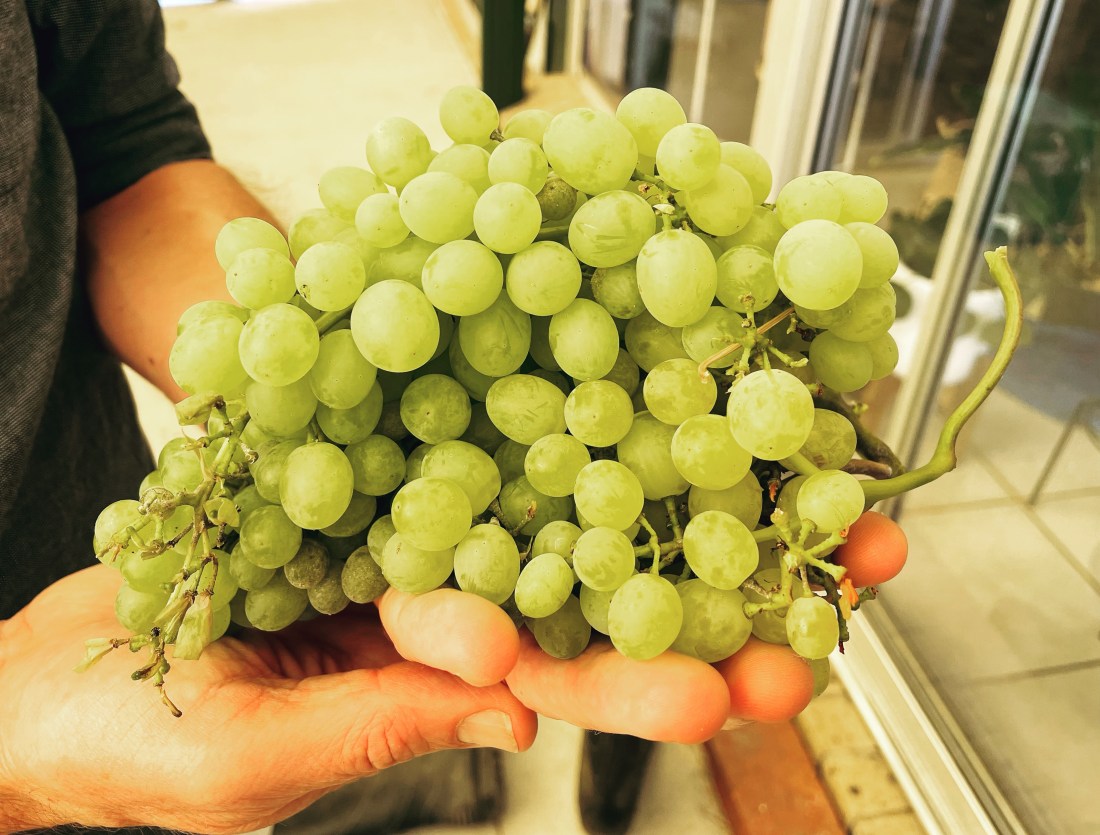
Before building the trellis, we picked our first bunch of grapes from our two year old vine. I planted the grape vine because my youngest loves grapes and looks forward to grape season every year. I like grapes, but I would rather eat a new season apple any day. However, I have to say that I felt crazily excited about picking the first bunch of grapes – more than I felt picking the first apples from our trees. They tasted really good.

Succession Planting

I’m experimenting with succession planting. After my great success with carrots this year, I have started planting fresh seed about every 8 weeks, with the goal of always having a supply of fresh carrots. I’m doing the same with beetroots and trying to do the same with onions. I haven’t had to buy a carrot or onion in months. You could argue that carrots and onions are dead cheap, and why would I bother taking up garden space for them?

Organic carrots and onions aren’t cheap, firstly. Conventionally grown carrots and onions are, but the veggies I grow are organic, no sprays, fungicides, or pesticides. They taste amazing. A homegrown carrot tastes special. Also, I can grow interesting varieties, like purple or yellow carrots, little round Paris Market carrots, and lovely long red onions.

Of course, I can do this because I have the space to continually grow rows of carrots and onions.

Late Season Planting

Summer is heating up late this year, so I am taking advantage of the late season warmth to throw in some extra veggies (in addition to the carrot and onions). I have thrown in some extra cucumber and zucchini seedlings to try to get some extra zucchini and cukes before the cooler weather kicks in.

I decided to spend a bit of money, and bought a propagation kit, which included an electric heat mat so I can start seeds for Autumn inside. I have started spinach and chard (silverbeet) now, to see how the heat mat works and familiarise myself with it, and because it is a bit early to grow out brassicas ready for planting in March. If that works well, I will grow all my caulis, cabbages, broccoli and kale from seed using the heat mat inside, and then plant out in March before the cold weather sets in.

Re-potting House Plants

My amazing Philodendron, that I bought as a tiny plant several years ago, has grown into a giant monster. It can no longer stay upright in its own pot or its cover pot, which means it is time for re-potting.

When I buy house plants, I generally buy the smaller, cheaper plants, and then challenge myself to grow them into the big plants that cost a bomb. I have grown a ten dollar Fiddle Leaf Fig into a lovely $80 specimen (the secret – lots of light and keep the leaves free of dust). I do this partly because I don’t like paying a hundred bucks for a plant, and also because I love the challenge.

When you buy a house plant, you should leave them in their existing pot, and place them in a cover pot. Keep them in their existing pot until they grow too large and need re-potting. You should be able to tell when the time is right.

Before re-potting

This philodendron had clearly outgrown its existing pot.

Original pot on the left, new pot on the right

I looked around in my potting shed for a new pot to upsize the plant. You can see how much bigger the new pot is than the old one: easily three times the size. This is because I don’t intend to re-pot this plant again for a long time.

I gently removed the plant from its existing pot, and soaked it in a bucket of water for a while. You can see how root-bound it is. Being root-bound is not a bad thing for house plants. Most house-plants prefer being root-bound, which is why re-potting should only occur once the original pot is clearly much too small.

I gently teased the roots out, being careful to make sure the soil from the roots fell into the bucket of water. I placed a layer of good quality potting mix into the base of the new pot, and then placed the plant in the bottom. Then, I tipped the water and soil from the bucket back over the plant. I did this because the plant is healthy and happy. The healthy microbes and fungi from this plant’s existing soil should be saved as much as possible and returned to it. If the plant was sick, I would not have done that.

I topped up the pot with fresh potting mix, making sure it was as upright as possible.

Now I just need to find a big enough cover pot – the basked I had it in is too small! Such a shame, I hate shopping for pots…

Gardening jobs, Easter Weekend 2021

I run my own business, and things are flat out right now, so I do not have the time to spend four days outside in the glorious Autumn weather, more’s the pity.

I gave myself one full day off, and the rest was to be spent looking outside at my garden from my study window.

Bee-attracting Dahlias

Good Friday: working.

Easter Saturday: Day off at the Meadows Easter Fair, a family tradition of many years.

Easter Sunday: working.

Easter Monday: working.

Easter Saturday

The Meadows Easter Fair is held in the little town of Meadows, about twenty minutes from our place. We trek along every year with close friends. We have the stalls we visit each year, and the items we always look out for. It is a traditional country fair, complete with hot donuts, sausage sizzle, homemade jams and pickles, and marshmallow rabbits. Our kids love it, even at the ages of 16 and 12.

There are also a lot of plants for sale. This year there were fewer plants of the kind that I was looking for, but I did manage to buy some Dutch Iris and Daffodil bulbs to plant in the front yard. The Daffodil bulbs were a plain yellow called Greg’s Favourite, which I bought mostly because I was tickled by the name. The Dutch Iris were a lovely ochre coloured variety called Bronze Beauty, which I have not seen in any of the catalogues (and you better believe I’ve been reading the catalogues).

Easter Sunday

Welllllll…I’m only human. Before I sat down to work, I gave myself a little bit of time in the garden. I have many indoor houseplants, and several of them needed dividing and repotting. I spent about an hour doing this, as well as taking cuttings from the overgrown Swiss Cheese Plant that has gone crazy in my study. I repotted the Fiddle Leaf Fig and a Hoya, and divided a Pothos Snow Queen.

Happy broccoli plant

I also repotted the silverbeet seedlings I have been growing from seed, and then watered all the repotted and divided plants with seaweed extract.

Then I checked all the brassica seedlings for caterpillars. I couldn’t find any, although I can tell that something has been having a little munch. I also noticed white fly around the place. The longer warm period has kept them hanging around. Generally I don’t spray, even with organic sprays because they can also kill beneficial insects, but if the white fly does get worse I might have to.

I cultivated around the brassicas to remove some opportunistic weeds (and some tomato seedlings that have popped up from the compost).

I quickly threw around some poppy and hollyhock seeds from my stash of seeds.

Then I waved goodbye to my lovely garden, and headed back inside to face my computer screen.

Next weekend, if I have time, I will plant out peas, sweet peas, garlic, and the bulbs I bought at the Easter Fair. Until then, it is time to work.

A beginner’s guide to indoor plants (by a beginner)

My grandmother always had a couple of pots of African violets on her windowsill, and a cyclamen in her house. My mother has always had a maidenhair fern in the bathroom and a jade plant in an interesting pot at the front and back door (for luck). But you may have noticed that lately every dude with designer facial hair and a one gear bicycle has a fiddle leaf fig in his house.

Indoor plants are cool now.

I have a number of indoor plants (because cool, see), but although I am an old hand at outdoor gardening, I am a total noob when it comes to indoor gardening. These are the plants I have right now:

  • Sedum or Jellybean plant x 2;
  • Pincushion Cactus (Mammillaria),
  • Pachyphytum hookeri;
  • Pachyphytum kimnachii (my favourite succulent – it looks like some sort of crystalline growth on a cave floor);
  • Fiddle leaf fig;
  • Fatsia;
  • Philodendron;
  • Aspidistra elata;
  • Peperomia variegated;
  • Diefferbachia;
  • Pothos (Devil’s Ivy).

I have also killed several plants, including several Freckle Faces for some reason. These are basically a weed, so killing these takes true talent.

These are my tips for keeping my houseplants alive and looking healthy and happy:

  • Watch the plant. My philodendron, Albert, was initially in the lounge room. He was miserable. His leaves would start off beautifully, then start to crisp around the edges and turn brown and wilt. I was not overwatering, and he was fed a slow release fertiliser for pot plants, so feeding was not the problem. I realised that light was the problem. Philodendrons have enormous leaves almost the size of small plates, which I figured were for photosynthesis. I moved Albert to our sunroom, which as the name suggests, is a much lighter room. Albert is now my most beautiful houseplant, happily unfurling leaf after gorgeous leaf. Every time I go out to the sunroom, I have to stop and look at him.
  • Keep an eye on light and temperature. The plants that I have killed have died due to either a lack of light (one bathroom is too dark) or too much heat (the other bathroom has a north facing window and plants placed there quickly crisped up and died). I have a houseplant in my office at work, and I bring it outside regularly for some sunlight and fresh air. I know my colleagues think I am slightly cracked because about once a week I take my little ‘friend’ for a walk outside. Houseplants can also die due to to overexposure to indoor heating, so I generally do not keep houseplants in my living area, where we have a fireplace going in Winter, and ducted cooling in Summer. The exception is one Sedum (Jellybean plant), which sits over the kitchen sink. It seems to be fine because the moisture from the sink keeps the air nice and moist.
  • Clean the plant. Houseplants collect dust. The dust clogs up the plant and prevents it from properly photosynthesising. I clean my houseplants every few weeks with tepid water to which I have added a few drops of olive oil. The olive oil helps to shine big houseplant leaves. Obviously, I don’t clean succulents.
  • Think about water. I only water my houseplants with bottled spring water. This seems like a wasteful choice, but in fact the spring water is a waste product in my house, because my eldest daughter buys water when she is out and then doesn’t drink it all (yes, I have suggested a thousand times that she takes a reusable water bottle, but she rarely remembers). I started using her leftover water on my plants rather than tip it down the sink, and discovered that my houseplants seemed to thrive on it more than tap water. My non-scientific guess is that it doesn’t have chlorine in it. Of course, if my daughter ever does listen to me and starts taking her own water bottle, then I will have to think about what else to do. Filtered water would be an option, or leaving tap water out for several hours for the chlorine to evaporate might also work.
  • Don’t overwater. This is the most commonly cited instruction for houseplants, but it is true. My plants get watered when I have a spring water bottle to empty. I check the dirt in the pot with my finger. If my finger comes back dirty, I move on to water a different plant. For my succulents, I have some cool German made self-watering pots that I found at the Melbourne International Flower and Garden Show. Pretty swish.
  • Feed. I use a slow release fertiliser especially designed for pot plants. I don’t feed the succulents.
  • Use cover pots. I don’t repot pot houseplants, generally speaking. I take the original plastic pot and place it inside an attractive cover pot. That way, I disturb the plant as little as possible. If the plant turns out to need repotting down the track, I will do it, but so far I have not had to do that. The only plants I have repotted are the two succulents pictured below. I re-potted them into the self-watering pots, which came with a special potting medium.
  • Elevate, if possible. If the plants are not on a shelf or a table, I use plant stands. I have found some el cheapo stands from K-Mart ($5-$8), and from Mitre 10 for $14. I personally think this keeps the plants looking good and helps keep them pest-free, but that could be confirmation bias on my part. I don’t see any pests on my plants, so those bug-fighting plant stands must be working…

That’s it – that’s all I know. I’m still learning, but since I killed the last Freckle Face last year, I have managed to keep all my houseplants alive and most are now starting to look pretty great.

One last note on plant choice: I’m kind of a tightwad. I don’t buy expensive mature plants. My most expensive plant was about $15. I figure the point and fun of a plant is to grow it. I understand if you are a decorator or designer, it might be worth spending a lot of money on an expensive mature plant, but that reason doesn’t exist for most people. If I were to buy Albert as he is now, he would probably cost about $65. I think I paid about $12, then helped him to grow into the beautiful plant he is now. I had much more fun doing it this way, plus every time I look at that plant I feel like a proud Mama. I just wouldn’t feel that satisfaction if I had bought him that way.

Also, imagine if you killed a $65 houseplant? You’d feel pretty f$#!ed off.

Twelve bucks: I feel the pain, but not so much.