We are finally getting some sunny days – not many, but a few. It’s still chilly, but it is wonderful to see the sunshine!
Most of the fruit trees are covered in blossom, even the tiny little miniature peach tree I bought on a whim a few weeks ago. It’s called a Pixzee Mini Peach, and I could not resist its adorable tininess when I saw it at the Big Green Shed.
‘Pixzee’ Peach Tree
Bees are going absolutely crazy out there – they don’t know where to start, whether it’s the apricot tree, the plum trees, or the rather spectacular Crimson-Flowered Broadbeans. These heirlooms will produce regular looking broadies but look super cool in the veggie patch.
I’m also growing a big block of dwarf broadies, which also look lovely – but not as speccy.
In weather like this, I want desperately to be in the garden, yet it is still too cold to plant anything in the ground. So all I can do is get ready for warmer times.
Celeriac
I’m growing celeriac in one of the wicking beds – a bit of an experiment to see if root veggies will do well in the greenhouse. Of course, I should have tried something that a) grows faster and b) I have grown before. But I am always adventurous, and I had the seeds, so I gave them a crack. The thing with celeriac, is that it is glacially slow. It takes well over 100 days to reach maturity. I might not have the patience for that, tbh.
Celeriac is such an interesting plant, with its cool warty roots and lovely nutty taste. It’s also pretty expensive to buy – at my local greengrocer, which is not overly expensive, individual roots were selling last week for eight dollars each!
The plants have grown beautifully and look super healthy – but they are not yet swelling at the roots. To help boost them along, I thinned the plants out today, which I hate doing, but it really needed to be done to give them the space they needed to expand. Then I trimmed some of the extraneous side leaves so the plants would put more energy into root development. Lastly, I gave them a side dressing of granular fruit & vegetable fertiliser.
Seedlings
I’ve been growing eggplants, tomatoes, chillies, basil, and capsicum from seed in the greenhouse for the past month. With the warmer weather, they have started to take off!
One variety of tomato, Violet Jasper, was ready to be pricked out into larger pots today. This year, I’m experimenting with recycled yoghurt pots as the Stage 1 pot – they are a good size (not too big not too small), free (free-ish anyway, given we buy the yoghurt, but we do that anyway), and will reuse the pots several times before they go in the recycling bin. My husband drilled drainage holes in the pots for me, and I filled them with my proprietary blend of equal parts seed raising mix, perlite and coarse propagating sand.
As only the Violet Jasper were ready, I used the remaining pots to plant some zucchini Cocozelle, pumpkinGolden Nugget, and cucumber Poinsett. There are varying opinions about whether growing zucchini and other curcubits for planting out is a good idea – some say not, others yes. I’ve done both ways, and my opinion is that it doesn’t matter very much. I want to take advantage of the greenhouse to start my plants while it is still cool outside, so I’m doing it this way. It’s so much colder where I live than on the plains, so taking the risk of transplant shock is worth it to me.
I also planted out a feijoa (Pineapple Guava) tree in a pot. My husband is originally from New Zealand, where the feijoa is beloved. They don’t really appeal to me (I don’t enjoy the strong perfumey flavour), but he will love having them around and I’ll enjoy growing the tree. I do quite enjoy feijoa jam, so if the tree produces enough I may make that one day.
As my husband had his drill out, I asked him to help me build a new climbing frame for climbing beans (similar to the one below).
Climbing Frame
He also fixed the passionfruit vine trellis, which was sagging due to the heavy weight of the passionfruit. Next week I will lean the axe against the passionfruit as a reminder that if it doesn’t produce any fruit this season, it will definitely get the chop.
I also built several trellises for my future pumpkins.
Picking
This time of the year is not as abundant in the garden as the Summer months, but we are still picking some veggies to supplement our diet. We are picking heaps of greens (lettuce, spinach, herbs), rhubarb, and cumquats.
Cos Lettuce
To fill in the hungry gap, I planted more lettuce seeds and spring onions today. About two weeks ago I also planted more bok choy and some rocket. Hopefully these will keep us going until the Summer plants take off!
I’m so excited for the next few months in the garden!
How about you – what are you doing to prepare for the warmer weather in your patch?
As I have already mentioned, this Summer, pumpkins will feature heavily in my patch.
However, these will not be the only veggies I will be growing in my garden. I have tried not to go overboard buying seeds this Season (a bad habit of mine), and have also tried really hard to only buy seeds for plants I really want to eat. I have been given to garden experimentation in the past, but this season I really wanted to focus on giving up now my increasingly precious garden space to veggies that everyone in the family will really want to eat and that grows well in my microclimate. So I’m farewelling okra, even though we quite enjoy it, because it is just not productive enough in my garden to give it garden space. I’ll buy a bag of frozen okra if we want some.
Aside from the pumpkins (Anna Swartz, QueenslandBlue, Butternut, Buttercup, Jack Be Little, and Galeux D’Eysines), I will grow climbing beans, a melon or two, cucumbers, zucchini/squash, tomatoes, eggplant, capsicum, basil, and chillies. The varieties are:
Eggplant: Rosa Bianca, Ping Tung Long, Listada de Gandia, Tsakoniki, Caspar;
These will be planted in the patch (pumpkins, zucchini, melons, beans), in containers (chillies, capsicum) and in the greenhouse (the rest). I have already planted the tomatoes and eggplant seeds in the greenhouse so they get an early start. As they grow into seedlings I will pot them on into larger pots so they develop stronger root systems before planting out in large wicking beds in the greenhouse. I find that even in the hottest of our Summer days, eggplants, cucumbers, and tomatoes do better in the greenhouse than in the patch – in fact, before we had the greenhouse I could never grow a single cucumber. My mother, who lives about half an hour away on the Adelaide Plains, is the queen of cucumber growing – I could not work out why I couldn’t grow cucumbers successfully.
Part of the issue is our elevation. We live on a hilltop at an elevation about 200m above sea level, compared to the Adelaide Plains (elevation about 50m above sea level). While our elevation does not compare to the hills and mountains we saw on a recent trip to New Zealand, it does make a difference. Family members living on the Plains report ripe fruit on tomato bushes and mulberry trees at least six weeks before our trees even show immature fruit. My cousin, who lives about an hour and a half north of us, is already picking asparagus, while mine is yet to poke its head up (my asparagus is also not planted in the best spot – I will need to move it in Autumn). My eldest daughter, who lives 15 minutes away downhill, has ripe fruit on her apricot tree several weeks before we do on ours. Our backyard microclimate is quite a lot cooler than her sunny backyard just 15 minutes away.
Understanding the impact of microclimates can make such a difference to growing success in your patch. I can’t grow pumpkins in the greenhouse (too humid, not enough space), but being fortunate enough to have a greenhouse means that I can grow other fruiting vines that need an extra boost of warmth.
What are you planning to grow in your veggie patch this Summer? Let me know in the comments!
The blog, like my garden, has mostly lain fallow for the past few months. I had a major project deadline to reach, which meant I worked 12 weeks worth of hours in 4 weeks. When I finished the project I decided to take a few days off, and predictably fell ill with the plague a nasty cold. All my gardening plans fell by the wayside while I languished in bed, cursing.
But resting makes time for planning. In between watching old episodes of Bones and reading delightfully silly Sookie Stackhouse novels, I also did some planning for my Spring and Summer veggie patch.
You might recall that I decided to grow green manures and legumes in my veggie patch over Autumn and Winter, letting my soil rest for the whole cool season. This was after my disastrous ‘no dig’ experiment, which left me with a rocky, dry, rootbound patch of sad looking soil.
Planning for Water
I am hoping that after this season of rest, my soil will be much happier and willing to take on some heavy producing plants. Think pumpkins, pumpkins, pumpkins. Last season was incredibly disappointing for pumpkins, which I mostly put down to the terrible weather. However, I do not believe that was the only reason. I think that the dodgy soil and my watering regimen was also a problem. I hope that this season’s soil repair efforts will make a big difference, but I have also decided that it is well past time to give up my old-school watering system (hose and sprinkler). This is just not serving me well anymore, partly because I am getting older, and partly because it takes way too much time (the part-time gardener’s most limited resource), and most of all because it just not efficient. This last year was the driest on record. My water bill for the Summer quarter was our highest on record. Something has to give.
From my sickbed I did some desktop research and contacted the highest rated and most consistently well-reviewed irrigation company near me, and asked them to quote. They contacted me five minutes later, and I organised for them to come out a few days later, when I was not so cooty-filled. They said they were not worried about my cooties and came out two days ago. While I sat in the weak sunshine feeling sorry for my snotty self, they measured and took photos, and then sent me an incredible quote (think about 25% of what I was expecting to pay) for an irrigation system for the entire veggie bed and all my backyard fruit trees. They are coming to install next week. If they do a good job, I will ask them to quote for the front yard fruit trees as well. If this system shaves down my Summer water bill and saves me time on watering, it will be money very well spent. If it improves my pumpkin growing experience, it will be worth its weight in…pumpkins. Which are quite heavy.
Last year was a singular disappointment in the pumpkin department. I refuse to live that disappointment again. That is the main reason for investing in the irrigation system. My brother had a spectacular melon patch last year, and he had installed a watering system. Pumpkins and watermelons are cousins, so I figured it was time to stop being a cheap stubborn old biddy and just do it already.
If you build it, they will come. Pumpkins, that is.
Planning for Spring
Spring is a great time to grow a quick cheeky crop of greens
The idea that we have four seasons that correspond to European seasons (but backwards) does not really fly in Australia. The Kaurna people, who are the traditional owners of the Adelaide Plains and the lands on which I live, describe four seasons, but start about a month later than we traditionally believe (i.e. Wirltuti or Spring, starts in October, not September, and Summer or Warltati starts in January, not December). That makes a lot of sense to me, when you consider that our September weather is still often so cold we have continue to run the heating at night. The soil is still often not warm enough to plant tomatoes outside until mid-October.
That means it is possible to plant a crop of cool season plants in Spring, if you plan well.
I don’t plant cool season veggies that take a long time to reach maturity in Spring (i.e. no cabbages or anything that has to form a head), but it is still worth planning to grow quick growing cool season veggies that will fill the so-called ‘hungry gap’ between the Spring and Summer harvest. This Spring I am planting:
I ordered a batch of el cheapo bargain seeds from one of my favourite suppliers, Happy Valley seeds, when they had a $1 a packet sale. Even if a few of these run to seed when the warmer weather hits, it doesn’t really matter much. At $1 a packet, if I can harvest a quick crop I will have done well.
I still have a healthy crop of spinach, bok choy, coriander and dill that I am harvesting now in the greenhouse, and a small crop of celeriac in a wicking bed that I am keeping my eye on. That may not reach maturity before the hot weather hits – it was always a risk to grow it in a wicking bed, but I am hoping it will start growing lovely warty roots soon.
Planning for Summer
Pumpkins, pumpkins, pumpkins
I have a clear plan for my Summer garden this year, and it involves pumpkins.
Pumpkins, you say?
Pumpkins, pumpkins, pumpkins.
Also, beans, eggplants, chillies, zucchini, cucumbers, and tomatoes.
But mostly, pumpkins.
To be honest, I love growing pumpkins much more than I love eating them. They are so beautiful, have so many varieties, and are just fun.
This year, in addition to the old faithfuls (Butternut, Buttercup, Queensland Blue), I am going to try:
All ordered online from the Diggers Club, the home of funky heirloom pumpkins.
On the bean trellis I am trying several kinds of climbing beans. I enjoy eating fresh green beans more than I enjoy eating pumpkins, to be honest, but for some reason, growing pumpkins is just so much more fun. So most available garden space will be handed over to the pumpkins. I may try a melon in with the pumpkins, despite my annual vow to never grow melons again.
Everything else (tomatoes, eggplants, etc) will go in the greenhouse. I ordered the eggplant, cucumber, and tomato seeds from Diggers Club and they arrived in less than a week, along with a native finger lime and lemongrass plant that I ordered on a whim, just coz.
On one sunny day when I felt slightly less like death warmed up, I staggered out to the greenhouse, masked up to avoid breathing in any dust and crud, and planted some eggplant and tomato seeds. Then I crawled back into bed.
I’ve been a bit late to planting this season, because I’ve been working non-stop, seven days a week. Unfortunately, just at the best possible time of year to be out in the garden, I am also usually the busiest, work-wise. My little office overlooks my front garden, and I have been watching the Spring garden bloom away while I have been working away. It’s kind of a bummer, to be honest. But not having any money is also kind of a bummer, so I have sucked it up and looked forward to the time it all settles down and I can get back out there.
That time is now, before the next major project starts (any day now). Carpe diem, my friends.
This weekend I spent the first full day in six weeks out in the garden. There was a *lot* to do out there, from digging up the used brassica plants, to a heckton of weeding, to feeding and mulching, to planting. Let’s just say at the end of the day I was in some state of pain. Seven days a week sitting at a desk is not good conditioning for a day spent digging and weeding.
It was lovely though, to be outside in the sunshine, not thinking about the election of schmonaldschrump and focusing on what I can personally do to make my little patch of the world more beautiful and sustainable and healthy.
I tried to make some ruthless decisions about what to plant this year, based on experience about what has continually succeeded and failed in my garden over the past couple of years. I’m kicking out melons this year, and have carefully selected the type of eggplants, chillies, and capsicums. I tried to reduce the number of tomatoes but I have to admit I failed at that, big time. I’m trying to grow a lot more beans (both bush and climbing).
I am continuing the okra experiment, but it is not going well at all. After transplanting from the greenhouse, they are spindly and slow-growing. My husband thinks they will do better in the greenhouse as it is more humid, and he may be right, considering their natural habitat. I might plant some in the greenhouse and compare their growth to the open garden beds. I know that the cucumbers do not do well in my open garden beds, but in the greenhouse they do really well.
The cucumbers are getting even more greenhouse space this season – we love them fresh and pickled, but it does depend on the pickle recipe. I did both sliced and spears last season, and the spears recipe was not very tasty (waste of delicious cucumbers!). We still have some and I will get through them, but it makes me a bit cranky when I make a pickle recipe that is not as delicious as it should be. There is no excuse for a bad pickle, when they could be so good.
Zucchini, squash, and pumpkins are also getting generous garden space. Last year’s pumpkins were a bit average. I love growing pumpkins, but I grew an heirloom variety that did not do well and wasted a whole season and a heck of a lot of garden space (Wrinkled Butternut – way less productive than the regular tried and true Butternut and much less tasty – my recommendation is not to bother). This year I am still experimenting with an heirloom (Musque deProvence) but also growing the tried and true Kent, which always kicks butt in my patch. From now on, I will combine an experimental pumpkin with a trusted variety so if the experiment does not work out I will still have the trusted pumpkin in pocket.
This year I am growing:
Beans: Kentucky Wonder Wax (Climbing), Cherokee Trail of Tears (Climbing), Goldrush (Bush). When I spotted Cherokee Trail of Tears I knew I had to grow it. This was apparently the bean that the Cherokee brought with them from their homelands and carried it with them all along the Trail of Tears – heirloom seeds tell a story of the people that have grown it, and this is a devastating story of horror but also resilience. To grow it and save the seeds is to honour their resilience and history;
Cucumber: Marketmore, Dragon’s Egg, Jefferson, and another one I can’t remember the name of! I grow Marketmore every year, it is a real trooper of a cuke, good disease resistance and is prolific;
Tomatoes/Tomatillo: Black Cherry, Black Russian, Jaune Flamme, Costoluto Fiorentino, Azoychka, Tomatillos;
Zucchini: Tromboncino, Ronde de Nice, Cocozelle.
This year’s planting decisions were made based on: what we like to eat and the cuisine we mainly cook (Indian, Italian, Mexican, all vegetarian), what grows well in my garden, what I have space to grow, watering requirements, and what I have the time to take care of.
How about you – what are you growing in your patch this Summer?
Still picking chillies almost at the end of Autumn
It’s been several weeks since I’ve been out in my garden. I’ve been working almost non-stop for six weeks, punctuated by one heck of a respiratory virus that knocked me on my butt. So, six weeks has gone by with little more than a wishful glance outside my window to watch the leaves on my pomegranate slowly turn golden.
Technically, it’s Autumn. I say technically, because with the change to our weather patterns, mid-May is still dry and quite warm in our part of the world.
We have had almost no rain since late January, and the long-range weather forecast is for very little rain to the end of the month and the start of Winter. These warm, dry autumnal conditions are sadly becoming the norm in Southern Australia.
While this has enabled me to continue to grow some Summer veggies into late Summer/early Autumn, it has also delayed planting of cool Winter veggies. I have planted turnip and swede seeds, and I have planted out some brassica seeds. But I am also picking tomatoes, tomatillos, and chillies, two weeks before the start of Winter. And I don’t mean from the greenhouse – I’m talking from the outside garden patch. That should tell you how warm the soil and air temps still are.
Summer Garden Duds
At the end of the season, I always review the season’s successes and duds, to help me think about what to plant the following year.
This year, the absolute losers have been the eggplants. It breaks my heart to tell this tale yet again (last year, they were the losers as well).
I adore eggplants, but honestly all my efforts have led to a couple of meals-worth of mixed eggplant from about 15 plants.
Why were they duds, yet again?
The cool start to the Summer season was the main reason. They grew slowly, not putting on much growth until quite late. As they took so long to pick up, pests set in, particularly the little jerk spider mite, which has been the bane of gardeners in our region this year. After I got on top of the spider mite, the aphids have set in to take advantage of already weakened plants.
I think the other reason is that I was lured by the seed catalogues to try fancy heirloom varieties instead of going with old faithfuls that are known to do well in our areas. Instead of going with the classics, such as Lebanese or Bonica, I just had to try the bright red, white egg, and Thai ball varieties. This is nothing against heirlooms. I love growing heirlooms, particularly tomatoes, and most do very well in my garden. But you do have to select carefully, and I think I was not careful enough in my selections. The varieties I chose just don’t do that well in our region. Next year I’m reverting back to the classic varieties that have stood the test of time in South Australian gardens.
Another dud was again, as usual, melons. If I say I am trying melons ever again, someone send me a comment or message to remind me that I cannot grow melons in my area. It doesn’t seem to matter if it is in the garden bed or the greenhouse, it doesn’t matter if it is an heirloom or a hybrid, full-size or a mini – if it is a melon, it just ain’t fruiting in my garden.
The other dud in my patch this year was, unusually for me, pumpkins. I understand that this has been the case for many gardeners in our region, so will try not to take it personally. Usually, I have a good run with pumpkins of all types. This season, perhaps again due to the late start to the season, I had healthy vines but not that many pumpkins. In the end I picked seven pumpkins. That’s not terrible but not great for me.
My mother has had a bumper crop of Butternuts from her tiny courtyard garden down the hill on the Adelaide Plains, which goes to show it can be done.
The lower early Summer temps also caused some issues with Summer squash. This year I had a few nice, big, Bennings Green Tint squash before they just started fasciating due to the low temperatures. Fasciation is a rare mutation that can occur in certain plants exposed to lower-than-normal temperatures. Squash and zucchini can be affected, causing contorted flower production at the end of a stem. Several squash plants started off well, produced fruit, and then fasciation set in. It did look quite cool though.
Summer Garden Wins
I have had some great wins this year though. The biggest winner was our Travatt apricot tree, which went bananas (er…apricots) and gave us the biggest crop of fresh apricots we have ever had. We gave away, we dried, we stewed, we bottled, we jammed, we gorged. If apricots were dollars, we were filthy rich in golden orange goodness for about a month. It was awesome.
The other winners were chillies, tomatoes, cucumbers (yay), tomatillos, and zucchini.
I wrote about chillies recently. We have had an excellent crop this year, and they continue to produce.
While tomatoes have not been prolific enough to make sauce, they have been really delicious. We grew three varieties this year: Green Zebra, Riesentraube, and Mysterioso, which I have mentioned before is an unknown beefsteak variety I grew from a storebought tomato. All three have been good, although the Green Zebra has outperformed in terms of productivity, while the Mysterioso is my favourite for size (huge! One slice fits a piece of toast or a sandwich – crazy!) and flavour (so sweet). My husband prefers the Green Zebra, as he loves the firm texture and tang. We have planted another crop of both in the greenhouse. My friend K has a crazy prolific cherry tomato plant that popped up in their garden – I have saved seeds from that and am giving it a go. Will let you know how K’s Tomato does on the productivity and taste test – seedlings went into pots last weekend.
Related to the tomatoes are the lovely tomatillos. I have not grown these for many years, but when we were in Tasmania last year, I bought some seed at Salamanca Markets. The other seeds I bought at the same stall turned out not to grow too well in my region (Hobart and Adelaide – not being very similar, weather wise), but the tomatillos have done well. We have a freezer full of salsa verde, and another bagful of whole tomatillos in the freezer ready for when we run out of salsa. Considering how often we eat Mexican food, I would say that will be pretty soon. Aside from the usefulness and deliciousness, I love growing them for their lovely flowers and beautiful growth habit.
Cucumbers were another great win, and probably my proudest. I have not always had success growing cucumbers. I love them – particularly pickled – but also fresh for snacks and in salads, and homegrown taste so delicious. But my efforts have been very pitiful, until this year. I have grown a huge number in the early season, that we enjoyed in salads, as little snacks, and then I made pickled spears and sliced cucumber pickles for burgers and sandwiches. I could not have been prouder of the jars of cucumber pickles in my pantry – not so much for the pickles, but because I actually succeeded in growing enough cucumbers to make pickles! I grew several varieties, including Marketmore and Mini White, and Gherkin. So far Marketmore and Gherkin were the winners for productivity and resistance to powdery mildew.
Zucchini have always been a bit hit-or-miss at our place. Some years we have a good crop, and other years, quite average. This year, I took a chance and planted Tromboccino, an heirloom zucchini that is a bit like a pumpkin, growing on a climbing vine that spreads all over the place. It produces long, skinny fruit with a bulbous end (like a trumpet or trombone – hence its name). I love this plant. Zucchini is one of my favourite vegetables, but when they grow too large they can become quite watery. Tromboccino stays lovely and firm even if you forget to pick it, makes delicious pickles, curries, or pasta, and keeps for a long time. You need space to grow it though, as it will run rampant across the garden. It produces for months.
I did try a couple of other zucchini this year – Rondo, Black Beauty, Cocozelle – but tbh none of them really took off like the Tromboccini. Given garden space is at a premium and that Tromboccino takes up so much of it, next year I will just grow Tromboccino and let it go hard. I will keep trialling some Summer squash though.
How about you – what were your garden winners and losers this year?
This weekend my nibling and nephew (aged 9 and 11) came to spend some time with us in the garden.
Gardening with kids is one of those things that, if you get it wrong, you can put them off gardening for life. Make it too boring or hard, and they may never want to do it again. Give them the opportunity to have fun while learning, and perhaps they will look back on that experience in a positive light. Even more hopefully, they may decide to take up gardening themselves one day.
We knew they were coming for a finite time, so my husband and I brainstormed a little about what we could get them to do. The activities had to be safe, first and foremost, and engaging enough to keep two kids occupied for a couple of hours. My garden is a large, working, productive veggie patch. While I do have flowers in the garden, and while I think it is beautiful, it is not really a place devoted to decorative plants. Kids often think ‘flowers’ when they think ‘garden.’ That might be disappointing for some kids. I did consider popping out to the nursery to buy some flowers for them to plant, but I ran out of time. These two kiddos know my patch pretty well though, so I thought they would be OK not planting flowers. In fact, they might have been disappointed if that is what I had suggested.
These were the easy, entertaining, safe, and helpful activities I had two curious kids help me with in the garden:
Watering the balcony garden;
Spraying aphids with potassium soap spray (non-toxic and easy to do);
Watering the greenhouse plants with liquid fertiliser (again, non-toxic – I did the measuring out and he did the watering);
Watering all the pot plants in the patio;
Planting broad beans and lettuce seeds;
Hand-pollinating cucumbers and eggplant;
Feeding the chickens and collecting the eggs (a perennial favourite with kiddos).
After watering – we used watering cans, not hoses (we have learned from experience!) – we spent time showing them how to hand pollinate different plants. They were fascinated that some plants need a male and female flower (cucumbers, zucchini, pumpkins) and some plants are buzz-pollinated (eggplant, capsicum, chillies, tomatoes). They loved feeling the spiky-soft cucumber leaves, and were interested in how droopy they were because they needed water. After we showed them how to buzz pollinate an eggplant with an electric toothbrush, and hand-pollinated the cucumbers, we looked around the garden at other plants that have different pollination methods.
I think it is so helpful for kids to see how the plants they eat are formed and grow. My nibling was fascinated by the cucumber plants, and searched out the baby cucumbers among the vines. They were very interested in the different types (I am growing three different varieties at the moment), and the fact that homegrown cucumbers have little spikes – so different from the smooth cukes they are used to from the supermarket.
After hand-pollinating the cucumbers (and a promise they could come back to see the growth later in the week), we moved on to planting seeds.
I chose to plant broad beans and lettuces with them because the seeds are so different. Broad beans are large (larger than a child’s fingernail) and lettuce seeds are tiny. Lettuces also often have funny names, and these were no exception: Flashy Trout Back and Great Lakes. It was a good experience for the kids to plant the broad beans as deep as their knuckles (or phalanges, as my nephew informed me, lol), and then lightly sprinkle the lettuce seeds on top of the soil and lightly cover with seed-raising mix. Planting seeds of different sizes helps kids to learn about biodiversity.
My kids are grown up now, so it was lovely to spend some time outside with young ones. I got to show them some of the crazy veggies I picked this morning, like the bowlful of Tromboccino zucchini. I had them guess why they were called that, and pretended to play it like a trumpet – uber daggy – but that is what crazy gardening aunties are allowed to do.
Tips for involving kids in the garden
Plan activities that kids can do – think about their age and abilities. If a child has a disability, plan activities they can manage, or make the task accessible for them.
Remember, safety first – don’t have them using power tools!
Choose activities that are fun and keep their interest. Plan specifically for the child you will be spending time with. Some kids might enjoy weeding, while others will complain mightily about that task. A couple of autistic kids I know (including my own) love weeding and will happily do that for ages.
Plan a list of short, active tasks with a quick reward or payoff. Kids (and tbh, many adults) will be more engaged if they can see the results of their activities – for example, watering, planting, or picking. I did not get them to pick zucchinis today because a knife was required for that task.
Stand back. While some tasks need you to closely supervise, it’s best to give them the space to try things independently. Because we chose safe tasks, we could take a step back and give them the space to do the tasks themselves.
Split them up. We had a 1:1 ratio of adults to kids. These are two well-behaved kiddos, however any kids can bug each other after a while. For some activities, we split them up. For example, one kid watered the balcony and another the greenhouse. That kept water horseplay to a minimum. For planting and pollinating, they came back together.
Don’t forget to break up the time with cold drinks, ice blocks or fruit, and chats. We always keep a stash of juice ice blocks in the freezer for when they visit.
Remind them to wash their hands after gardening and before eating and drinking if they have been in the garden. Soil is full of microorganisms that can carry nasties.
We love chilli so much, there is a whole shelf of our fridge dedicated to all things chilli: hot sauces, gochuchang, chilli pastes, chilli crisp, chilli oils, curry pastes, sriracha, salsas, chilli pickles, sambals…to be honest, it’s starting to take over other parts of the fridge now too. We also make our own chilli pickles.
We eat chilli with every meal. Our family has South East Asian heritage, so we grew up eating Indian meals very regularly, and at home we eat curries a couple of times a week, along with Mexican food at least once or twice a week. The other nights, we usually have Korean (spicy), Chinese (spicy) or Italian (spicy). We sprinkle hot sauce or drizzle chilli oil on our breakfast eggs or drop pickled chillies in our tomato and cheese toasties at lunchtime. There is not really a single meal that chilli does not touch. Possibly dessert, although if they still made those awesome chilli Tim Tams…(that’s a hint, Arnott’s).
For the past couple of years, a nearby town has hosted a chill festival each February, and for the past couple of years, we have attended. It was on again last weekend – and we rolled up once more, because we love, love, love chilli. It’s such a fun event, made more special this year because a friend was promoting her business, Uu-Mah-Mia at this year’s event. Her Chilli Crunch product is locally made in Alice Springs, and is fabulous.
Other great products there were our local favourite, Salt Gang (we love their Italo Crisp chilli oil, which is amazing on pizzas, pasta, on eggs – we go through it faster than any other condiment in our fridge), and this Victorian mob that grows and produces their own chillies and tomatillos to make hot sauces and Cowboy Candy and Toffee from jalapeños. OMG – it’s amazing stuff.
And when we got home from the Chilli Festival, after tasting multiple types of chilli products, buying more chilli plants and with chilli crisp, hot sauce, and Cowboy Candy in tow, my husband decided it was time to make chilli paste. He made a sambal from our homegrown Habaneros and Devil’s Tongue chillies, and it just about blew the roof off the house. We might need a biohazard sticker for the jar.
Chilli Varieties
In addition to the chilli fridge, we also grow a lot of chillies – at least twelve different varieties at last count.
It’s rare that I find a chilli I don’t enjoy, although it occasionally happens. I have a high tolerance for heat, but I don’t want a chilli that is so hot I don’t enjoy the flavour. I like a hot chilli, such as the Scorpion or Habanero, but I want the chilli to taste delicious as well. Conversely, I enjoy some milder chillies, such as the jalapeño or Curly Toenail, if they have a lovely bright or sweet flavour.
What I don’t like is a chilli with a flat, unpleasant, or dull flavour, no matter the spice level. Three that I have grown recently and found very unpleasant or boring are the Purple Maui (very hot but not very tasty), Dragon Roll (no heat, dull flavour) and the Mango (spicy, very prolific, but very unpleasant flavour). I’d go so far as to say I hated the Mango chilli and would never want it near my garden again. What was even more annoying was that it grew like crazy, was totally pest-resistant, and we were inundated with the little monsters. At least it was attractive. Mango and Purple Maui might be worth growing for their decorative fruit, I guess, if there were not other chillies equally pretty and with much better flavour.
My favourites this year have been (in no particular order):
Jalapeño – it’s a classic for a reason. Delicious, versatile, warm but not too hot, great for eating fresh, pickling, in salsas and curries, resistant to pests, and keeps on producing for months;
Curly Toenail – of course, the name is a winner, and the way it grows is so fun – long and skinny and curling up at the end. But it also tastes lovely, with a nice heat – but not too much. Versatile for Mexican and Indian food. Not super prolific, but enough to make it worthwhile. I overwintered this from last year’s Chilli Festival and it has kept on producing.
Anaheim – a mild, large chilli with a delicious flavour, great for Mexican food. For the flavour fans, not the heat freaks.
Devil’s Tongue – a lovely, hot, vibrant yellow-orange chilli with great flavour. Spicy, tasty, bumpy, prolific, one DT will heat a whole curry easily. Not very easy to find, worth seeking out from specialty suppliers.
Cayenne – just so pretty. What we think of when we think of ‘chilli’ – long, red, glossy, gorgeous. Warm and delicious. The classic chilli.
Habanero – a hot little monster, used to be considered the hottest in the world at 500,000 Scovilles (the heat measurement for chillies) until it was usurped by the new range of extreme chillies (i.e. the Carolina Reaper). But I prefer it to the extreme chillies because it has a lovely flavour and brightness, in addition to the heat.
Mustard Habanero – a variety of habanero, yellow-orange in colour instead of the darker red-orange of the traditional habanero. The fruit is also larger. Flavour and heat profile is similar, but I love it because it is so pretty as well.
Fresno – Similar to a jalapeño, but larger and fatter, and quite hot when it ripens to red. Delicious sliced up on a pizza, if you like your pizza with a little heat.
Scorpion – Hot, fresh tasting and quite juicy, pest-resistant, and prolific.
I won’t bother growing the Serrano, Siam, Bhut Jolokia, or Joe’s Long again next year – they were either just ‘ok’ or were too susceptible to pests to make the grade, in my opinion. Siam grew really well, but I didn’t enjoy the texture – it had a tough, waxy texture that I found a bit unpleasant, although it tasted alright. Joe’s Long was pleasantly flavoured and definitely attractive, but was not hot enough. And Serrano and Bhut Jolokia just attracted too many bugs. In fact, after I publish this, I am heading out to dump the last of these in the compost.
Growing Chillies
I grow almost all chillies from seed, purchased either from Happy Valley seeds or the Digger’s Club. I did buy a couple of plants from the Big Green Shed or from the 2023 and 2024 Chilli Festivals, including the Scorpion, Anaheim, Fresno, and Curly Toenail. The Chilli Festival is great for finding some unusual or hard to find plants.
I raise the seedlings in tubs in the greenhouse in August/September, pricking them out when they are a few centimetres high and hardening them off in single ten centimetre pots. Once they are well-established, I plant them out into larger pots.
Chillies are really easy to grow both in pots and in the garden bed. I mostly grow them in pots on my balcony and in the greenhouse. Next season, I will skip the greenhouse and put them on the balcony only – while they love the warmth of the greenhouse and grow prolifically there, in that warm, humid space they are more likely to fall prey to pests, namely aphids, white fly and the little jerk spider mite. On the open air balcony, they are less productive but are largely pest-free.
In my experience, some chilli varieties are more prone to pests than others. This year, the Bhut Jolokia (also known as the Ghost Chilli) and the Serrano have been most pest-prone – we have barely had a single fruit from these plants. The most productive and pest resistant have been the jalapeño – which is great, because it’s also the most useful – and the Scorpion. I bought that last year at the Chilli Festival, and it overwintered really well and then exploded into a profusion of pale orange and very hot little fruit. We find that half a Scorpion is lovely in a pasta dish; a whole Scorpion is good for something spicier, like a curry. Don’t pickle them though! I make a delicious lime and fresh chilli pickle that usually requires green chillies (jalapenos or other fresh green chilli). I ran out of the full quantity for a double recipe, and topped up with ripe Scorpions. I think my husband burned a hole in his oesophagus.
Chillies are fairly un-fussy plants: grow in full sun in a decent sized pot (although they will not really complain if the pot is not very big), pop some slow-release fertiliser for veggies in the pot, and give them a regular liquid feed every two weeks. If you are growing them in a pot, make sure to water them daily so they don’t dry out.
You can overwinter your favourites at the end of the growing season. In March, cut them back hard, and leave them in a sheltered place. Then wait for them to re-shoot in Spring, and then repot with fresh potting mix. If you don’t want to give them that space, save the seeds from a ripe chilli by drying them out on a plate, and save in an envelope, and plant out again next year. I will be doing that with my Anaheim, Jalapeño, Fresno, Cayenne, Curly Toenail, Mustard Habanero and Habanero, and Devil’s Tongue this year.
Is there a chilli variety that you love to grow – or one that you really dislike? Let me know – I am always looking for new chilli plants to try!
February is a strange time in Southern Australia. It’s usually the hottest month, with many of the summer veggies such as beans and cucumbers almost at their end, but at the same time, it is usually too late to sow any new Summer plants. This year however, the late start to the season has the tomatoes, capsicums, eggplant, and chillies just kicking off. We are stuffing ourselves with fresh tomatoes in salads, salsas, on toast, and in pasta every day, and eating delicious fajitas with homegrown zucchini, drizzled with salsa made of tomatillos, green zebra tomatoes and jalapenos, pulled out of the garden that morning. It’s bliss – everything I have ever wanted in a garden.
To keep the Summer abundance going, I’m risking some late plantings with the hope of a longer season. I’ve planted more cucumbers, taking care to choose varieties that can apparently resist the powdery mildew (Jefferson’s Cucumber and Dragon’s Egg). I’ve planted a heap of dwarf beans (Dior bush beans) all over the garden in spots where I could poke a seed, with the hope of a quick extra bean harvest, if I’m lucky. We have eaten so many green beans this year, it has been fantastic.
I’ve raised some extra squash and zucchini plants, hoping we can get a couple of rounds of extra zuccs, as they are just my favourite veggies along with eggplant, and I live in hope. I’ve even taken a punt and planted some more tomato seeds – I have a greenhouse, so I think I can get another full tomato harvest before Winter sets in. I’m trialling late plantings of cherry and saucing tomatoes (Black Cherry, San Marzano).
Preparing for the Winter garden
Oddly at the same time I have just planted another round of tomatoes, I’ve also started planting brassicas for Winter. I have never grown Brussels Sprouts. I’ve always believed that our area is too warm for them to be successful. That might still be the case – but I recently read an article about growing them and decided to have a go. Brussels Sprouts must be started in February for success, as they need a long growing season, so today when planting my extra tomatoes I planted the first batch of Catskills Brussels Sprouts seeds. Hopefully they pop up soon and I can put another round in. If I succeed in growing Brussels Sprouts, I will be bragging so hard.
Catskills Brussels Sprouts
I also planted more Cos lettuce and dill seeds. I have recently discovered the wonder of fresh dill, and now all our salads are sprinkled with fresh dill and basil. My kids aren’t really fans of it, so I have to soften the dilly approach a little.
Some Summer garden duds
There have been some duds though, I’m not gonna lie. The Red Ruffle Eggplant have been a huge disappointment, and so have the Turkish Red Eggplant – in fact, eggplant in general have not responded well to the cool, wet start to the season. I have picked enough for one meal so far – definitely not the eggplanty-dreams I was hoping for. A batch of Armenian Striped Cucumbers fell prey to powdery mildew as soon as I planted them, without even offering a single cuke. Once again, melons have been a disappointment – why, oh why, do I keep planting them? And I have been battling the little jerk Red Spider Mite in the greenhouse for half the season. A mild soap spray seems to be doing the trick, but I have to be on top of it constantly.
Bye-bye Pepino
Speaking of garden duds, about two years ago I bought a pepino plant from the Big Green Shed and put it in the patch against the fence. To say it grew prolifically would be an understatement. That thing quadrupled, then quadrupled again. It saw off several passionfruit that came only to say hello, then gently expired. It flowered, and flowered, yet only bore mature orange fruit a handful of times. The fruit did not really appeal that much to anyone, tasting like a weird mini rockmelon. And still it grew. By mid-January this year, it took up a square metre of back garden space. And that is when I decided its number was up. That much garden space is far too precious to be taken up by a freeloading plant that no-one likes.
I think it took me well over an hour and a thousand calories to dig the thing up, but it has now been removed to the green bin where it belongs, and several squash and zucchini plants are sunning themselves in its place.
Good riddance.
This is a lesson to me not to be suckered in by something promoted by a garden centre, and to do a bit of research before planting something in my edible garden. I should have read up about how large the pepino grows, and what it tastes like. If I had just googled ‘what does a pepino taste like’ the first result would have informed me that it is ‘a delicate combination of cantaloupe and honeydew melon.’ I dislike both of those flavours, and so does my family. So, note to self: check these things.
But if you have plenty of space and you love melon, I can recommend a fast-growing bush apparently known as the “Year-Round Rockmelon”!
What to do in the garden with the time you have this week
Houseplants need attention this time of year. During Summer, houseplants are in growth mode, and are also prone to drying out in the warmer weather. Indoor houseplant gardening is still gardening, and requires focused attention to keep things looking good – in fact I would argue it requires more care and attention, because a dodgy looking houseplant is more annoying on a daily basis than a dodgy looking zucchini plant.
If you have an hour
Take cuttings and propagate in water. The warm weather is ideal for propagating houseplant cuttings. This weekend I took cuttings of Harlequin (Marble Queen) Devil’s Ivy (a gorgeous variegated Pothos with lovely marbled leaves), Scindapsus Golden Queen, and Dragon’s Tail (Epipremnum Pinnatum), and have placed them all in water to strike. I was careful to take the cuttings under a node where the plant will easily sprout a root. These plants strike very quickly just in water.
If you have 2-3 hours
Clean, water, trim, and feed your houseplants. Houseplants should be cleaned regularly, as the leaves collect dust, which prevents transpiration. In a tub of tepid water, add a drop of olive oil. With a soft cloth or paper towel, dip in the water and olive oil and wring out and clean the leaves of dust. The olive oil will give a gentle shine.
Using scissors or snips, remove dead or bedraggled looking leaves. Feed the plants with either slow-release prills such as Osmocote (my preferred) or Thrive for pots or planters, or a liquid feed for pot plants (I use the Powerfeed spray for indoor plants), and water your plants.
Depending on the number of plants you have, this task can take a couple of hours, by the time you clean, trim, water, and feed everything. I have quite a few plants, including hanging plants, so it generally takes me about two hours to complete, every couple of months. I know it is time to do it when my favourite houseplant, the beautiful giant DiffenbachiaReflector in my bedroom loses its lustre and bright neon and green colouring.
My huge spotted Begonia was also looking peaky, so I placed it in a bucket in the laundry and soaked it overnight in a tub of water. I find this treatment, once every six weeks or so, keeps it happy.
If you have 4-5 hours
Around this time of year, you will find some of your houseplants need re-potting. I have been looking at my houseplants since Christmas (and ignoring them), fully aware that about ten of them needed repotting. These included my Fiddle-Leaf Fig, Harlequin Pothos, a Silver Sword Philodendron (philodendrum hastatum) that was looking about as miserable as it was possible to look, and a floppy Monstera.
Repotting is easy but messy, so do it outside. Fill a bucket with water and some seaweed extract. Remove the plants from their existing pots, and soak them, soil and all, in the bucket. I was shocked to see how dried out some of them were. Let the plants soak for fifteen minutes, or until the water has penetrated the soil and roots. While it is soaking, give the plant a trim of dodgy looking leaves, and if you want to, take a cutting or two to propagate into new plants. I find that most houseplants can be easily propagated in either water or in sand or seed-raising mix. The easiest plants to propagate in my experience are pothos (Devil’s Ivy), spider plants, and spotted begonia (in fact these last two are so easy that I have had to stop propagating because I have too many).
Meanwhile, take new or recycled plastic pots in the next size up, and half fill with fresh potting mix.
When the plant has had a lovely soak and are wet all the way through, tease the root ball out a bit – not too much – and place it in the new pot. It’s ok if some of the existing soil comes along for the ride. Backfill with new potting mix and add a tablespoon or so of slow-release fertiliser for pot plants. Place the plastic pot in a cover pot, and water.
Remember that when you increase the size of the plastic pot, the cover pot you were using may no longer fit your plant. You may have to do some moving around.
Wash the old pots well with water mixed with a splash of methylated spirits or rubbing alcohol to clean properly, so you have pots for next time. Then clean up all that mess!
Again, the time this task will take depends on the number of plants you have to repot and the mess you make. I’m notorious for making a big mess (I figure, make a mess, apologise later), so I usually have a pile of old dirt, pots, and junk to clean up afterwards. But that is half the fun. Compost the old potting mix, recycle the pots, and try to waste as little as possible.
You can move your newly potted plants directly indoors, or if you want to you can also put them in a sheltered position to acclimate to their new pots. I tend to immediately place them where I intend them to live.
The long hot, El Nino-dominated Summer we were promised has not really eventuated: instead we have been hit with a coolish, damp, stormy season – more reminiscent of the sub-tropics than the warm temperate climate we are used to in Southern Australia. I feel like the weather has not honoured the bargain I make every year: I agree to put up with the cold and wet from late Autumn until mid-Spring, and then I am rewarded for my (admittedly grumbling) forbearance with a lovely warm Summer in which to bask. I guess climate change is making fools of all of us, and there will be no more handshake deals with the weather from now on.
There have been some benefits and downsides to this lower temperature, wetter Summer. The benefits are obviously more water around, which has kept trees and plants hydrated well into January. My garden looks lush. Usually by mid-Summer in our area, things are starting to look a little dusty. This year, the extra water, followed by bursts of warmth, has led to heavy, lush growth, so my backyard resembles a little jungle of tomatoes, squash, and beans. I have never had a bean crop like I have had this year! Obviously, I have been too stingy on the water in the past – if I want to replicate the results of this year, future me will need to increase the water ratio in the veggie patch.
Apricotapalooza
We also had the largest apricot crop we have ever had. I think that is both due to the abundance of water, and a heavy late-Summer prune my husband gave the tree last year. We had about 200 kg of apricots from our one Travatt apricot tree. It was delicious, amazing, and overwhelming. We gave away about half the crop to friends, family, and neighbours. We preserved them, jammed, dehydrated, stewed, and ate them fresh. We made ice cream. We ate apricots until we were almost orange. At one point, I called my sister, begging her to come and get some apricots. She popped around to take some off my hands and took some for her friend as well. It was a great problem to have, but seriously, it was a bit overwhelming.
To save the crop from the wet weather and the parrots, we had to pick them as soon as they started to blush. Apricots continue to ripen off the tree, so it is fine to pick them a little underripe, and it is also preferable to preserve them when slightly underripe.
It’s Tomato Town
Just as the apricots finished, the tomatoes have started to ripen. This year I grew four main varieties: Riesentraube (a cherry tomato), Green Zebra (my favourite heirloom, green and yellow striped, sweet and tangy), San Marzano (an heirloom saucing tomato), and Mysterioso – a tomato I grew from saved seed and had forgotten both the colour, flavour, and name of. Now that it has fruited, it appears to be a Black tomato – possibly a Black Russian, a lovely black ribbed beefsteak tomato that is sweet to eat and can grow as large as my hand. We are eating tomatoes every day for multiple meals – on toast for lunch, with pasta, in salads, as salsa. When the San Marzano ripen, we will make sauce.
The tomatillos have also started to ripen. Tomatillos are also known as husk tomatoes, although they are not actually a tomato. They look a bit like a cape gooseberry: they grow with a lovely papery husk around them. On the bush they look pretty, like little paper lanterns.
Once ripe, the husk dries off and they are ready to pick. Peel the papery husk off (the fruit feels sticky once peeled, so do not peel until you are ready to use) and wash before making salsa verde (green salsa). I’m currently testing different recipes to see which is the best way of cooking these. They are incredibly prolific. I have about six plants and they are going off. I intend to can as much salsa as I can for the later months. We eat a lot of Mexican food.
Mulberry Success
After five years of disappointment, our efforts with the mulberry tree have been rewarded by an actual mulberry crop! It’s not a big enough crop to make mulberry jam or anything like that, but we are picking about a cup of mulberries a day at the moment. Unlike previous years, the mulberries are fat and juicy. When we pick them, the juice runs down our hands. I put this down to diligent watering and feeding over the past year.
Thanks to the prolific veggie patch and fruit trees, we have not had to buy any veggies or fruit from the supermarket, except mushrooms, onions and potatoes for over a month – not a bad effort at all!
This weather has also caused problems though. The storms, rain, and wind, followed by warmth, are a perfect breeding ground for powdery mildew on squash, zucchini, and pumpkins. I have had to pull out vines just as they start to produce because the mildew has taken over. I can’t manage it with usual fixes (Ecofungicide, diluted milk spray). The weather is also causing plants like zucchini to produce only male flowers or only female flowers, creating pollination problems. And the cold-warm-cold weather is wreaking havoc on hot weather loving plants like eggplant, that are taking forever to produce anything at all. So while the green beans are happy and producing, I have sulking eggplant and mildewy zucchini. A vegetarian can’t live on green beans alone!
I’m choosing to see the positives. I think we can expect a longer period of this weather, heading into March and April. So, I am planting up another batch of cucumbers, squash and zucchini seeds to take the place of those I have already lost to the powdery mildew – I think I will have a good chance of a second crop. I have sought out some seeds of varieties that are supposedly more resistant to powdery mildew to see if they can last out the season – I’ll report back how they do. I intend to keep the greenhouse going in tomatoes, chillies, and cucumbers as far into Winter as I possibly can. In a few weeks, I will also start my seeds for brassicas for Autumn and Winter. Last Season wasn’t really productive in terms of the broccoli and cauliflower, so I have plans for different varieties, and also for a lot more root crops next season because I know these always do well in my garden – lots of turnips, swedes, and parsnips.
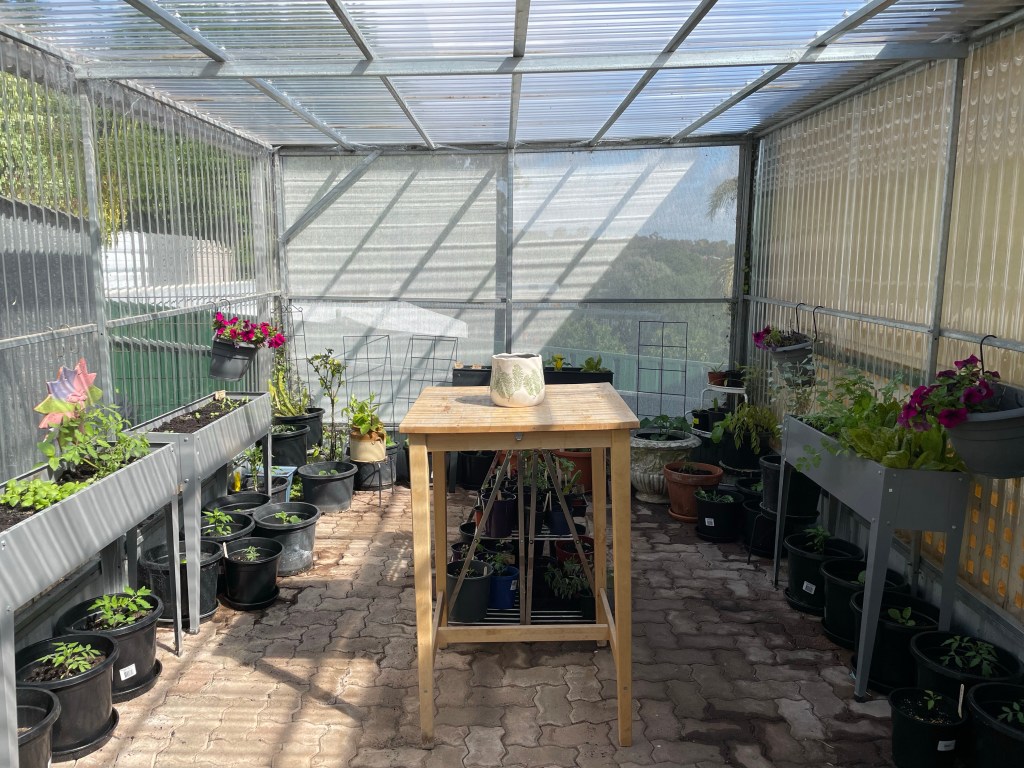
I’m a lucky duck – I have a big veggie garden and a greenhouse. The greenhouse was converted by our builder from an old tool shed. He removed the old tin sheets, and replaced with poly sheeting and white shade cloth for ventilation. Doing this mini-renovation on the old shed, which we were going to remove anyway, saved us about five thousand bucks and has created a much more sturdy and larger greenhouse than we could have had if I purchased a flat pack model online (which was my original intention). Thank goodness for innovative builders!
I love it. I mean, I love it. I can’t wait to go outside every morning to water it and see what has happened inside over the past 24 hours. I’m obsessed.
I grow almost all edible plants in the greenhouse, with the exception of a few ornamental cuttings I am striking. Aside from that, it is an oasis of fruiting plants and vegetables, especially this time of year.
But it’s also been a bit tricky to learn how to manage the greenhouse, compared to growing outside in the open. Last year, which was my first Summer with the greenhouse, I was inundated with aphids and it was not a fun time. I left it too late to treat them, and I could not stop the invasion. This is because I was used to growing outside in a very large space, where a bug here or there doesn’t matter much. Everything balances out. But in the greenhouse, which is its own little micro-climate, things don’t balance in the same way. It’s warm and humid, and the aphids and white fly just love it. Predators do come in, but they are also busy outside, where there are more flowers and other plants for them to work away on.
This year, I have been much more proactive. I keep yellow sticky strips in the greenhouse all year round, which has helped to keep the population of whitefly down. I have noticed that the whitefly attract the aphids, so keeping their population down helps. When I water, I keep an eye out for both, and if I see them I either squish them or give them a quick squirt with the hose as soon as I see them. If they still proliferate, that is when I spray. I found out the hard way that the recommended homemade soap spray (water mixed with dishwashing detergent and a little cooking oil) is fine in the open garden, but burns and kills plants in the greenhouse, due to the soap and oil hitting tender leaves in an environment of high heat and humidity. In addition to the hosing and squishing, I have been trying a homemade spray made of chopped tomato leaves soaked in water. That has been quite successful.
Soak tomato leaves in a bucket of water for several hours, up to overnight. I just filled the bucket with a many leaves as I was willing to pull off the tomato bushes and then topped up with water, then left to soak. Strain and pour into a spray bottle. I have found that the aphids steer clear, when combined with hosing them off pretty regularly.
The other pests I have struggled with recently is spider mites. These little buggers are much worse than aphids, as you can’t see them with the naked eye and you don’t notice you have them until the leaves of your plant start to show the telltale signs of damage (silvery leaves, tiny webs). I hate these jerks. They are really hard to get rid of and they spread quickly. A soap spray is the recommended treatment, but as I have already mentioned, in a greenhouse that is problematic. I have to choose a very cool day and hope for the best, or if the plant is too far gone, put it in the green bin.
Watering the greenhouse
Watering the greenhouse is a big job. While you can get away with skipping a day or two in the patch in hot weather, you can’t in the greenhouse. It is several degrees hotter in there, and everything is in containers. They must be watered or they will die. Simple as that.
When there were fewer pots in the greenhouse, I could manage with a couple of watering cans. Now, I need to use a watering gun and hose. We spent about $40 on a strong steel and brass watering gun, with the hope that it will last quite a few years, and now watering takes about ten minutes instead of half an hour – and I am not lifting heavy cans of water.
Be careful with saucers in the greenhouse as well. I have found that in they are susceptible to algae growth due to the higher humidity. While saucers may be preferable when growing containers on balconies or patios, I have mostly removed them in the greenhouse.
Pollination
Pollinators do come into the greenhouse – it’s not hermetically sealed (so do birds, and I think some other critters, judging by a couple of overturned pots I have found). I have spotted native bees and hoverflies in there several times. But my open veggie patch is a pollinator’s paradise, thanks to all the herbs and flowers I plant, and my mini-meadow. So the greenhouse gets short shrift from pollinators.
Things still fruit in there, but I needed to think about how I can increase pollination rates. I have came up with a few solutions.
The first is hand pollination of cucumbers and zucchini. This is easy: just strip off the petals of a male flower (the one without the swelling at the base) to expose the pollen filled stamens, and poke it in the female flower a couple of times. Some people are much fancier than me and use a paintbrush to delicately remove the pollen from the male flowers and dip it into the female flowers. You can do that if you like. I’m a little less refined than that.
The other thing I do is mimic the buzz/wind pollination process for tomatoes and related plants. Tomatoes are self-fertile but require wind or the visit of a busy bee to buzz alongside them and shake their pollen loose. The greenhouse is not as exposed to wind, and while bees do visit, most of them are buzzing around the borage outside. To address this, I have a cheap electric toothbrush (sans brush). I have taped up the poky end so as not to accidentally stab myself, and I gently buzz the top of each tomato flower. I don’t want to brag, but I can see the little puffs of pollen shake loose when I do this, so I think I am easily as good as a bee at this job.
Of course, it’s hard to explain to others. Like when my sister called and asked what that buzzing noise is. And I had to admit what I was actually doing. She said it sounded like the world’s most boring porno.
With all this effort, is it worth having a greenhouse?
I’m not going to lie, a greenhouse is an expensive exercise. Firstly, there’s the expense of building it in the first place. Then there’s the set up. This can be minimised in a couple of ways. We did this by converting the old toolshed, as I mentioned, and by recycling pots and shelving. We did buy some shelving and raised troughs online, but we have also sourced a lot of pots, shelving, and stands from our local Buy Nothing Group on Facebook. That has reduced the cost significantly, but there are still other expenses, such as the potting mix, water, and time. I can’t pretend it’s not a luxury, or that my five cucumbers yesterday couldn’t have been purchased yesterday for much cheaper than it cost me to grow them. However, once the greenhouse is built, and all the pots and shelves are in place, they can be reused almost indefinitely. The cost of the set up is spread over years, and the value will be maintained. The ongoing expenses of potting mix, water and time will remain.
Growing plants from seed also reduces the amount of plants I buy in seedling form, which does save money – so long as I resist spending too much on seeds. I can grow almost anything from seed in just a couple of weeks, which is amazing. 95% of the veggie garden this season has been grown from seed. That is so exciting to me, as a gardenerd and obsessive.
Aside from the fun, I can see the difference in plant size and productivity between plants in the greenhouse and in the open garden. I have cucumbers I planted in the greenhouse and in the garden at the same time. I am picking cukes from the greenhouse while the cucumbers I planted in the garden are still having a little chat with each other about whether they might possibly consider growing another millimetre this week. I have eggplant flowering in the greenhouse, while the eggplant in the garden are having a little stretch. It’s not that they can’t grow, it’s just that the weather is still so unpredictable this season, they are not sure why they should. Whereas the greenhouse, with its stable lovely warmth is just so conducive to growth.
So is it worth it? For me, it is, simply because gardening is my main hobby and great pleasure in life. Some people love cars, or music, or movies, or art. I love plants. If I had all the free time in the world, I would spend it in the garden. In real terms, it is a relatively cheap, and certainly an active and healthy hobby. I just wouldn’t suggest a greenhouse unless you have the space, money, and time to spend troubleshooting the challenges that can arise.