Weekend garden jobs, October 14 2023

Fernery, Sydney Botanic Gardens

We spent a few days in Sydney last week, in perfect weather. Aside from the usual things (Opera House, Harbour Bridge, ferry rides), we visited the Botanic Gardens, which had a beautiful rainforest section and a fernery.

The fernery was stunning. We learned a lot about how ferns reproduce, and the variety of ferns in Australia. I recommend a visit if you ever visit Sydney.

We also took a ferry ride to the ritzy suburb of Rose Bay. The reason we went there, aside from the fun ferry ride, was that it has a beautiful, bay with crystal clear water, and art deco buildings in pristine condition. It has streets lined with enormous trees – really gorgeous and worth the trip.

Greenhouse Jobs

I spent several hours rearranging my greenhouse this morning. My husband suggested making better use of the space by shifting some shelving to the centre of the greenhouse. This was a really smart idea, and it also gave me the opportunity to clear out some cobwebs, creeping oxalis that had wormed its way in, and sweep out the greenhouse. Once I did that, I moved a heap of pots around, moved the shelving racks to the centre, and then had the fun of potting up a lot of seedlings that were ready to move from the seed troughs.
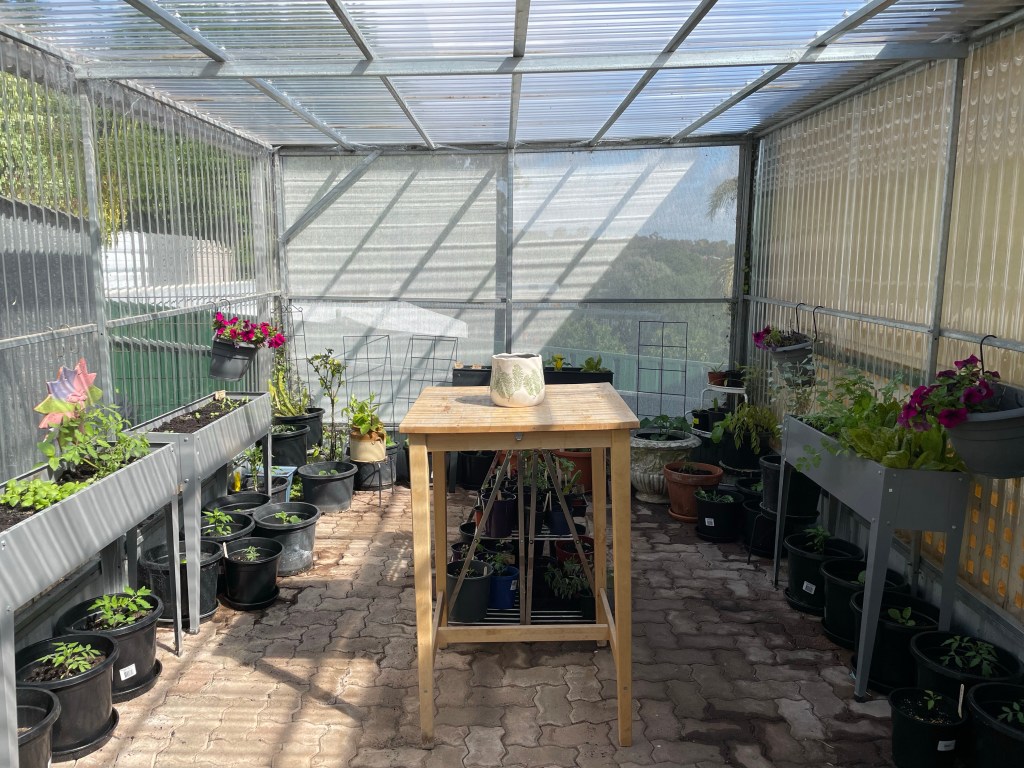
Rearranged Greenhouse

Mulching and weeding

Due to the combo of warm, sunny weather last week followed by cool rainy weather this week, the weeds have come out in full force. I have spent quite a lot of time trawling around the garden, bucket in hand, pulling out weeds. These were much worse in the front yard than the back, where I do admit to spending more of my time. Some kind of grass has found its way into the front garden, probably blown in, and I have finally given it my attention. Fortunately it was easy to yank up, but it really was all over the place.

Another job I have put off in the front yard was mulching (the back yard veggie patch has been properly mulched for several weeks now, in anticipation of the warmer weather). In the backyard I use a straw mulch (lucerne or sugar cane), but in the front yard I use a cottage mulch because it is more attractive. I finally started it today, and realised I really underestimated how much mulch I needed for this job!

Mulberry answers?

As I mulched and weeded, I listened to Roots and Shoots, an ABC gardening podcast from Western Australia. I also listen to the local Talkback Gardening podcast from here in South Australia, but when I have finished these, I turn to Sabrina in WA. Someone called in asking how often to water a mulberry tree during Spring. My mulberry tree is a current bane of my garden (you should see our back neighbour’s tree – covered in ripening mulberries! Our tree – tiny green fruits!). Sabrina said mulberry trees should be watered twice a week in Spring and three times a week in Summer. I water about half as often as she recommended – this could be the answer to my mulberry tree woes. I immediately put the hose on the mulberry tree.

Quinces and plums

It’s not all woe in my garden though! The plum trees we planted last year have tiny plums, the lime tree is covered in tiny limes once more, (after an absolute bumper crop last year), the apricot tree is loaded, and the quince tree we just planted six weeks ago is covered in blossom!

Smyrna Quince in bloom

Some people would recommend trimming blossom off a newly planted tree to let it put all its energy into growth. I just let the tree do its thing. That may not be the right approach, but it’s what I do.

The apple trees are also both covered in blossom, and we are hoping for a good crop this year.

On the other hand, I had to dig up the ring-barked passionfruit, leaving just one sad passionfruit left of the five I planted two years ago. I have two tiny Red Flamenco passionfruit growing from seed, still alive in the greenhouse. If these don’t make it, I might wave a white flag on passionfruit. It feels almost unAustralian, saying that.

What to do in the garden with the time you have this week

If, like me, you have minimal time, here’s some suggestions for what to do with it:

If you have an hour

Plant some zucchini and pumpkins. The soil has warmed up now (although it’s cold in our area today) – push some zucchini, pumpkin, or squash seeds direct where you want them to grow and wait. They will pop their heads up soon! I’m finding all the extra spots in the garden to poke a few pumpkin seeds, including the front yard.

If you have 2-3 hours

Keep mulching. I don’t know about you, but mulching takes me a long time (I’m not as young as I used to be, and my yards are big). I spent a couple hours on it a few weeks ago, and a couple hours today. I’m still not done. I hope to have finished all the mulching by the end of October, before the really hot weather hits.

If you have 4-5 hours

Start planning for Christmas. When I look at my garden now, I’m thinking about how it will look in eight weeks’ time. We often host, and I like the garden to look nice. Do I want plants to be in flower? It’s going to be a hot Summer, so everything will be a bit droopy unless I make sure to mulch and water well now and in the future. What about colour? If I want to have a display of flowers by Christmas I need to start planning for that now.

Creating a fruiting garden

Our garden has 17 fruit trees and vines:

  • Apricot (Travatt)
  • Grape (White Sultana)
  • Mulberry (Black)
  • Avocado (Reed)
  • Lemon
  • Lime (Tahitian)
  • Pomegranate (Azerbaijan)
  • Plums x 2 (Elephant Heart and Narabeen)
  • Apples x 2 (Cox’s Orange Pippin and Early Macintosh)
  • Blood Orange
  • Cumquat (Calamondin Green)
  • Blueberries x 2
  • Passionfruit (Nelly Kelly)
  • Pepino

We are also about to plant and espalier a quince (Smyrna) and our local council is also giving us a nectarine tree through their Adopt-a-fruit-tree program, soon bringing the total up to 19 fruiting trees. That should give you an indication, really, of just how much space we are fortunate to have in our yard.

You’d think with that many fruit trees, we’d be drowning in fruit all year round. Sometimes, we are. Right now, we have so, so many limes. I’ve given them away to friends and family (I offered them to a friend the other day and she politely declined – clearly, we have given her too many!). I’ve made just about every possible variation of lime pickle, jam, and chutney that it’s possible for one family to make. I’m out of ideas. We are limed out. In Summer, we had the biggest crop of apricots ever. Same deal. We still have them in the freezer. I also still have pomegranates in the fridge from Autumn as we slowly work our way through them (we have five littlies left).

Yet, for other trees, like the mulberry and apple trees, that much fruit is just a dream. Either the fruit is minimal at best, or the possums have crunched it up before we get to it. If we ever get an avocado, you will never stop hearing about it. I’ll brag about it for the rest of my life.

The fact is, growing fruit trees is a labour of love, and sometimes just a labour.

My goal in planting all these trees was to one day, never have to buy fruit again. Now I know that dream is a crock. Right now, I could eat only limes, but I think my family would object greatly to that. The fact is, I cannot really control the amount of fruit the trees will produce, as so many factors influence this, with weather being the main factor.

That doesn’t mean that growing fruit at home is not worth doing. Homegrown apricots are glorious. Homegrown limes are juicier and tastier than anything you can buy. Pomegranates cost five bucks each! I never buy them, but when I have them from my tree in May, I can decadently toss the juicy red arils on top of every curry or a tagine like the Sultan of Brunei.

Planning your fruit orchard

Before planting anything, consider your space and aspect. Fruit trees need space for their roots to spread. They also need full sun, ideally all day, but at least four hours daily. If you want to grow an orange tree and only have a shady corner of the garden, consider growing something else, or plant it in a large tub that can be placed in a sunny spot.

Speaking of tubs and pots, some fruit trees can be planted in tubs quite successfully, while others will struggle. Our lime tree was miserable and constantly attacked by scale when in a pot. When we moved it to the garden, it doubled in size and has not stopped fruiting since. However, our blueberry bushes and cumquat seem to be fine in pots.

Consider too, what you actually like eating. I enjoy growing fruits that are not easy to buy at the supermarket and that I can use to make jam and sauces. My husband likes to grow fruit he can eat fresh from the tree. We have compromised, and that is why we have the mix of trees we have. The pomegranate, cumquat, blood orange, lime, and pepino are for my fun experiments. The others are for fresh eating and also some for jam if we have any left over. However, if we had a smaller space, some of the more unique trees would not be in our garden. Fortunately, we have the space to include a wide range for our interests and tastes. If I was more limited in my options, the ‘no brainers’ would be an apricot, a lime or lemon, and a passionfruit vine.

Don’t forget, if you are limited on space, you can always grow up. We have five trees growing on trellises, by espaliering them. This has allowed us to grow many more trees than we could have if we had let them grow out instead of up. We have learned to do this by watching YouTube and visiting Botanic Gardens with espaliered trees. It’s not the cheapest way to do it (you have to buy posts, wires, hooks, etc), and it takes patience and practice. But it is an option if you have limited space, and can invest some dollars (about $50 per trellis).

Planting fruit trees

The old adage is that you plant a ten dollar tree in a hundred dollar hole. That means you should spend more time and money on preparing the soil than you spend on the tree itself. Most trees will thrive when grown in soil prepared with good quality compost, well-rotted sheep manure, and a side dressing of an organic fertiliser once planted. This doesn’t mean putting fertiliser in the hole when you plant. Prepare the soil with compost and manure a week or so before digging the hole.

On planting day, dig a hole twice as wide and deep as the root ball.

Make sure to tease out the roots so you are not planting roots that are tightly bound up. I like to soak the roots in a bucket of diluted seaweed extract for an hour or so before I plant. Then I put the plant in the hole, and pour the bucket of seaweed extract over the root ball and into the hole. I let it soak in, then back fill. Water in well. This gives the plant a good head start.

If you are mulching, make sure not to place the mulch right up to the trunk, as this can cause collar rot. Leave about five centimetres (2 inches) of free space around the trunk.

Some trees require special attention when planting. For example, an avocado tree should be planted on a mound with several bags of compost, then surrounded by a shade barrier to keep out wind and sun while establishing. Avocado trees are very sensitive to sun and wind burn, so taking the time to build a shade barrier will be worth your while, especially as avocado trees can cost upwards of $100. Check with your nursery for special instructions when buying your tree.

Now is the time to plant deciduous fruit trees (think apples, pears, plums, quinces, apricots, etc). I have a quince waiting to plant next weekend.

Caring for your orchard

Feed your trees! You won’t get fruit if you only give them a handful of Dynamic Lifter once a year. Fruiting trees are hungry plants, because they put a lot of energy into producing fruit.

At this time of year (mid-Winter), I give each tree a bag of pulverised, aged sheep manure. This rots down slowly over the season.

Then once Spring hits, my aim is to feed each tree with roughly two cups of Dynamic Lifter and blood and bone (combined) every month, until the end of fruiting season. That’s my goal but tbh, I am a bit hit and miss with it.

I also side dress each tree with compost progressively as I dig it out of my bins. Today the lime tree, blood orange, avocado, and both apple trees got the compost. I’ll keep working my way around the garden until each fruit tree gets a bucket or two of compost in the lead up to Spring. The compost is made of a mix of my chickens’ composted manure and litter, garden weeds, kitchen scraps, and occasionally a bag of my neighbour’s pigeon manure (pure gold). It’s very well composted down over several months and the trees love it.

And don’t forget to prune. We prune Summer fruiting trees (i.e. apricots, mulberries) after fruiting (late Summer/early Autumn), and then give them a light pruning to shape in Winter. The goal for trees like our apricot and mulberry tree is to create a lovely vase shape that will let light into the tree, and to prevent it growing too large.

This year we also lightly pruned our pomegranate for the first time, to remove some of the excess growth at the base, and the lime tree for the same reason.

Caring for fruit trees takes time and thought. We do it partly because the flavour of fresh, homegrown fruit cannot be beat, and because it’s fun. I also enjoy looking out of my office window and watching the rainbow lorikeets playing in the trees (even though I know they will steal the apricots as soon as they can).

A Virtual Tour of the Royal Tasmanian Botanical Gardens

Bumblebee on hydrangea

We have been fortunate to tale a trip around stunning Tasmania this past week, with the past few days based in Hobart. After a day spent at Salamanca Markets, and another at the Museum of Old and New Art, we walked to the Royal Tasmanian Botanical Gardens. Set on 14 hectares close to the centre of Hobart, the Gardens are one of the oldest botanical gardens in the Southern hemisphere (established in 1818). Our State was colonised in 1836, so the gardens are older than colonial settlement in our part of Australia. And it is obvious, just by the size of the trees. South Australia has some lovely trees, but they are teeny tiny compared to Tasmanian trees in the gardens, and even more so in the wild. I had heard the phrase ‘old growth forests,’ but I did not really understand the reality of it until coming to Tasmania. Trees here are giants. The RTBG has oak trees that could shelter the Merry Men. We have seen even larger trees since our visit to the botanical garden, but that was my first experience of really large trees.

Rose Arch – Pierre de Ronsard

My travelling companions took many photos (I’m not much of a photographer), which has allowed me to create this little virtual tour.

On arrival at the gardens, we were greeted at the gate by a friendly person who asked us our interests, handed us a map, and pointed us in the right direction. As our first goal was “COFFEE!”, she directed us to the cafe, and we stumbled forth. The cafe overlooks the water, so we sat for a while looking at the water and feeling very civilised before heading out on our garden walk.

Tasmanian Community Food Garden

Giant snowball pumpkin – you can’t tell from this photo, but it was about the size of a beach ball!

Once it was a working farm, then Pete Cundall established Pete’s Patch in this space, then it became the Tasmanian Community Food Garden, an organic community garden cared for by volunteers and community members. It produces four tonnes of fresh organic produce annually. On our visit, pumpkins, apples, tomatoes, pears, and herbs were growing in abundance.

I was happy to note that many of my own practices were also in evidence here. I did pick up some tips though: plant borage and calendula in among the pumpkins to encourage pollination. There were dozens of ripening pumpkins in the various pumpkin patches, so it clearly works.

Cinderella Pumpkins in the Community Food Garden

My husband took careful note of their technique for espaliering pears. We have multiple espaliered young fruit trees in our backyard but are always looking for more advice. The pear trees in this garden were beautiful, and covered with pears.

Much cooler is an apple tree arch. I wish I had space to recreate that in my garden.

Apple tree arch

I noted that the traditional ‘Summer’ crops that would be in full fruit in warmer States, such as chillies, zucchini, tomatoes, and eggplant, were not much in evidence here. There were a few healthy tomatoes and capsicum plants, but they already had brussels sprouts in the ground – we would not be planting these in SA for at least six weeks, and in my area probably not at all.

Japanese Garden

South Australia has a small but lovely Japanese Garden in the city. The RTBG Japanese Garden is about three times as large. It is beautiful, very tranquil, with many little hiding nooks for quiet contemplation. After a busy few days, I enjoyed finding a quiet spot to sit for 15 minutes.

Tasmanian Native Garden

Lemon Beautyheads

The Native Garden was quite large and clearly well-designed and considered. This was my favourite section of the RTBG, because it was so well-thought out, and I did not recognise many of the plants. Each plant was accompanied by a description of its traditional and medicinal uses.

Banksia

Conservatory

Exterior of the Conservatory

If you’re a reader of this blog, you’ll know I have a fascination with greenhouses. The RTBG has a gorgeous stone and glass conservatory, that houses a fountain and hothouse plants that would struggle to grow outside in Hobart’s cool temperate climate.

Fountain

The stone fountain was so relaxing it inspired me to consider adding a water feature to my garden. This is something I have avoided for many years, due to the maintenance. However, I think a solar powered water feature in the patio or greenhouse might be worth considering.

Interior of RTBG Conservatory

Of course, my greenhouse has been set aside for productive plants, while this Conservatory is decorative. I still found it inspirational. You can see a variegated ficus in the foreground of this photograph – beautiful! I’m going to search for one when I get home.

Heritage Cottage

The Heritage Cottage was the first building constructed in the gardens, and was originally a dwelling. Now it is a little museum showcasing some early botanical drawings and horticultural equipment, like an early terrarium design (see below).

Early Terrarium

My youngest and I both love botanical drawings and paintings, so we loved looking at the early colonial botanical drawings.

Statue outside Heritage Cottage

The Tasmanian Royal Botanical Gardens were my favourite place to visit in Hobart so far (we are going back to Hobart for a few more days). We spent most of the day there. If I lived in Tassie, I would visit regularly. If you are ever in Hobart, I recommend a trip – it is a beautiful, relaxing, and inspirational garden.

Gardening jobs, October 30 2021

Mulberries! Finally!

We spent almost eight hours in the garden today, building trellises for the fruit trees in Pie Corner. That is to say, my husband was building the trellises, while I did other stuff.

Firstly, I cleaned out the chook shed (boring but necessary), and collected seven (!!) eggs.

Then I mulched the entire back garden, which is a big job. However, it is definitely reaching the warmer part of the year, and mulching is a necessary task. It saves water and keeps weeds down. Over time, it breaks down and builds soil structure, and it stops the soil becoming hydrophobic, which can be a big problem in Australian soils. I use chopped sugar cane mulch, which is a sustainable by-product of the sugar cane industry. It’s cheaper than lucerne, and lighter, so it lets the water through. I have used it for years, and I think it does a great job. Some people prefer lucerne or pea straw, but I have compared both and I personally don’t think there is much of a difference except price.

Mulching a garden the size of ours takes quite a long time. I took little breaks to pick a kilo of rhubarb, a big bunch of silverbeet, and pull out most of the older plants to feed the chooks (much to their delight, it’s their favourite), weed the opportunistic weeds that came up after this week’s rain, and pick flowers for the house. Mulching is quite boring, so doing these jobs helped keep me going. I also had to water it in, so it doesn’t blow away and undo all my hard work.

Building trellises and espaliering fruit trees

This is how our old trellises looked:

Old trellis

They were ‘built’ from star droppers and wire, and were not large enough for the apple trees. The wire was casually looped around the star droppers, and could not be tightened, which meant that the wire sagged as the tree grew and the weight pulled on the wire. Also, the whole set up looked ugly. A dodge job all round.

New trellises with espaliered dwarf apple trees

This is the new set up, with newly espaliered apple trees. Some of the undergrowth you can see there are berry plants that are yet to be trained up a new trellis. Once they are moved onto a new trellis all of their own, it will look neater and nicer. Also, btw, expecting a bumper berry crop this year. The plants are covered in blossoms. Very excited about that. My husband loves the boysenberries, which is a pretty sweet reward for all his hard building work.

Espalier dwarf apple tree

The trellis has been built with wooden poles, strong wire rope, and turnbuckles to enable us to tighten the wire if it sags. We chose to use wood for the supports rather than metal, but you could use steel poles. We prefer wood for the aesthetic, and because it is much cheaper. We are building five large trellises across our garden, and need thirteen tall poles, so cost is an important consideration.

In addition to the three trellises in Pie Corner, we are building a large trellis along the back garden fence to support three passionfruit plants, green beans, cucumbers, and a pepino, and a trellis for our three year old grapevine. I want to use as much of my vertical space as possible.

The espaliering is probably not textbook, but as Homer Simpson says, it’s my first day. I’ll keep shaping and training them and soon, hopefully, they’ll look like some textbook French potager effort. Or at least, ok. Whatever, we’re getting apples, so it’s all good.

We’re also getting grapes on our grapevine for the first time. I’m very chuffed about that. I will guard these little baby grapes with my life. Or at least some kind of netting.

Hello, little baby grapelings

The rest of the day, I potted up more petunias and a new Chinese Jasmine I bought on a whim, and cleaned up the patio because we have guests visiting tomorrow. Our yard continues to look like a construction site as we always seem to be building something, but at least the patio is as tidy as it can be, and the house has lovely fresh flowers. I do hope the construction site is cleared away before Christmas though…is exactly what I said last year!

Maybe if I want that to happen I should stop asking his nibs to build stuff.

Gardening jobs, Christmas weekend 2020

Happy Christmas! Like most of you, I am happy to be just a few days away from the end of this shocker of a year. I chose to spend the Boxing Day public holiday (the 28th here in our State) in the garden. It has been a lovely, cool day with some sunshine and some cloud cover. Perfect for a long day spent in the garden.

Before I could do that, however, I had to remove this creature from the doorway. Look at the size of this redback! I have never seen such a big one, but my husband assures me he has. It was an inch long, including the legs.

Usually when we find a house spider, we move it outside, but venomous spiders are a different story. Under the thong it went. Sorry, giant bitey friend.

Bloody hell

Today was an important catch up day. With the pile of work I have had to finish, plus Christmas, those important garden jobs have fallen by the wayside. These include weeding, trimming, and feeding. The veggie garden is still looking pretty good, but everything needed a good side dressing of organic fertiliser. I picked all the tomatoes I could find before I fed the tomatoes with blood and bone and dynamic lifter. Then I gave them a liquid feed of seaweed extract, fish emulsion, and Epsom salts. The Epsom salts give magnesium to the tomatoes and help make the fruit sweeter. I add about one teaspoon to a ten litre watering can, along with the seaweed extract and fish emulsion, and water the tomato bushes as a foliar feed.

Bowl of tomatoes picked this morning

While I was out there, I quickly planted some more sunflowers, aquilegias (also known as Grannies Bonnets), and cornflowers, and some more climbing beans. Some of the beans I planted didn’t come up, so I filled in the gaps with fresh seed. Beans only set fruit after quite a few days over 30 degrees C – we have had cooler days this Summer, so it might be all in vain.

My front yard was looking especially tired after a beautiful Spring display. I used my little hedge trimmers to start work on the lavender bushes. This is a really big job, as I have one lavender bush taller than me, and about twelve or fourteen lavender bushes in all. I only managed to trim about five of them. It’s a work in progress. I am not trimming them too hard, as it is the middle of Summer, and a hard trim will stress them out too much. I really just want to remove all the dead heads and let the new flowers come through. Lavender is pretty tough though and I have not yet killed any with a light Summer pruning.

I also started carefully trimming the dead branches from the sage and salvia bushes. Again, I don’t want to stress the plants too much. I have also discovered that sage is not very forgiving of a hard prune at the wrong time of year. But, the sticks poking up all over the salvia look bloody horrible, so I decided to risk it. I will prune it a bit harder in Autumn.

The apricot tree has finished fruiting. As mentioned in my previous post, we let the parrots have some. As punishment for our kindness, I now have to go over the tree and remove the half-eaten dried out apricots from the branches to prevent bugs being attracted to the tree. It is a pretty gross job, tbh. On the plus side, I found one last, perfect apricot that somehow was missed by both parrots and us, and brought it inside to share with my husband for afternoon tea. I was able to find a single ripe apple (that the rats missed!) from our Cox’s Orange Pippin tree to go with it.

One delicious ripe apple – and one not yet ready

Finally, I removed all the plants from two raised garden beds that are not doing well, and soaked them in a bucket while I dismantled the beds. I spread all the planting medium around the garden, where it will compost away for the next few months. Then I planted the petunias and eggplant from the raised beds in the backyard, where they will hopefully pick up. I will figure out something else to plant where the raised beds, although honestly something will probably self-seed there in a few weeks and I will not have to worry about it.

It is already looking happier, and I will keep trimming lightly and tidying things up over the next few weekends until it looks back to full strength (or as good as it can over Summer). The front yard really looks best in Autumn and Spring, when the pomegranates are in full fruit, the perennials start to recover from the Summer heat, and the bulbs begin to grow. Until then, keeping it neat and tidy and alive is the best I can do.

Duds and triumphs

The Triumps

This season we have had some notable successes. Our apricot tree ripened early. Normally we pick apricots the week of Christmas, but this year the fruit was ready a week earlier. We picked almost ten kilograms of apricots, which is the biggest crop ever for our four year old tree (it’s a Travatt apricot). I’ve made jam and given some away. This afternoon if I have time, I am making apricot ice cream, and my favourite of all desserts, an apricot pie. I like eating fresh apricots, but in my opinion, apricots really come into their glory when cooked, and especially in pie form. Apple pie is pretty good, but apricot pie is amazing.

We pick the apricots when they first start to blush, and ripen them indoors. This is because we do not net the tree. We let the birds have a go at the fruit, and pick as much as we can ourselves. Some would disagree with this, but I figure there is a lot of fruit and the parrots need to eat as well. I like looking out at the tree and seeing rosellas and lorikeets having a ball out there. There is a lot of fruit for us and them. I do wish they would finish an entire apricot before starting on the next one though. Wasteful little buggers.

I do indeed mind sharing with rats, however. Our apple trees are finally fruiting after three years of patiently waiting, and I have been admiring a perfectly round, blushing apple, coveting it like Snow White’s stepmother. My husband discovered the other morning that the back end of it had been attacked by a gnawing little monster. You can imagine the stomping and cursing that ensued (from me, not him).

The pomegranate bush is going great guns this year – we had a mass of flowers and they are now forming beautiful baby pomegranates like lovely Christmas baubles. I love pomegranates. I love the look of the bush, the flowers, the beautiful globulous fruit, and the ruby juice. It is just a beautiful and undemanding plant. It requires almost no maintenance, little water, and gives so much.

Our tomato bushes are the garden triumph of the veggie patch this year. We are picking Tommy Toe and another cherry tomato called Sweet Bite that is living up to its name. The plants are healthy and abundant. I am hoping we end up with a great crop for sauce as well as eating fresh throughout Summer. I also have not yet managed to kill two cucumber plants (a miracle for me), although the chickens have eaten three others. I may yet achieve a homegrown cucumber, in which case you may hear me screaming from the rooftops.

The Duds

We have a couple of duds that, if they are not careful, will meet the Huntsman’s axe soon. Our mulberry tree is the same age as the apricot tree, and so far has produced almost nothing. There are a few pitiful berries on its branches that are stubbornly refusing to colour up. I alternately beg, plead, and curse the tree whenever I pass her, but she still refuses to do more than that. I do have a woodpile…

The other dud is the passionfruit vine, Odette. One great crop, and she thinks that is her job done. Well, I have news for her. I have plans for her patch of dirt if she can’t pony up some passionfruit next Summer.

But the biggest dud of all this year was our potato crop. After months of building up around healthy looking spud plants, I dug down to find…nothing. Nada. Zilch. I piled on the compost and straw and gave up precious garden space in the height of the annual growing season for nothing at all. Talk about crestfallen. My face dropped faster than Clark Kent’s pants in a phone booth.

Another dud was the red and white petunias I planted with plans of a lovely display by Christmas. What wasn’t dug up by one very, very, naughty chicken has largely dried up due to a lack of water (a visitor yesterday heard me telling this chicken off for digging up a new zucchini plant, and thought I was scolding a child. I had to explain, with a manic smile, why I was berating a bird). This is entirely my fault. I have been very busy with work over the past six weeks and while I have tried to maintain water all over the garden, the veggies and fruit trees have been prioritised over the poor flower gardens. I am going out this morning to replant the whole area in the hope that it can be salvaged – but to be honest, it probably cannot.

The point of this post is, no matter how much time we spend in our garden, and no matter our experience, we experience triumph and frustration in almost equal measure. Probably next year we will have a pitiful apricot crop and an amazing crop of something else unexpected. It’s part of the fun and learning experience of gardening.

Weekend garden jobs, November 21st 2020

My husband is working hard to finish the remaining half of the garden wall by the deadline I have kindly set for him (Christmas) – and he has almost finished! Who knew he just needed a deadline? Note to self…

If you ask me, he’s doing a bang up job

While he’s building, I am doing the other gardening jobs, like weeding, weeding, and weeding. Also, watering. We are heading into the driest time of the year, and if I want any tomatoes (or anything else), I need to be diligent with watering. It is not so much about amount of water, as consistent watering.

In between these pretty dull, but necessary tasks, I am admiring the fruiting plants. This year, we finally have an apple crop forming. We planted two dwarf apple trees three years ago, and so far have only managed to pick one small apple. This has been a source of intense frustration for me, as garden space is a premium. If it doesn’t pull its weight, I start to make plans for a woodpile.

Then finally this year, both trees bloomed simultaneously (a necessity, given they are supposed to pollinate each other), and we now have the makings of a delicious (I hope) crop of Early Macintoshes and Cox’s Orange Pippins. I have never tried either of these apples, as they are not grown commercially in Australia, but trusted sources inform me that the Cox’s Orange Pippin is one of the most delicious eating apples currently cultivated. It doesn’t transport well, which is why it is not available in shops

Also growing great guns are our boysenberries in Pie Corner.

Boysenberry ice cream time, I reckon

This is the largest crop we have ever had. My husband is pretty excited about these. He keeps going outside to check if they are ready yet (they aren’t). Given the great job he has been doing on the wall, I think I will give him first crack at them when they are. We also have raspberries coming on for the first time, and have recently planted thornless blackberries. Next year should be a Summer Berry festival around here.

And that’s yer lot. Weeding, watering, and making eyes at my fruit trees. Next weekend will be plus 40 degrees all weekend so the time will be spent keeping things alive.

Weekend gardening jobs, Weekend 2nd & 3rd November 2019

The title of this post is actually somewhat misleading: I have been going out to the garden every morning for an hour or so, even on weekdays. I made the decision to do this after I spent half an hour in bed trying to convince myself to get on the treadmill. I realised I could have spent that half an hour happily in the garden getting some exercise. With that thought, I jumped out of bed, and did spend an hour happily in the garden getting some exercise. Turns out, gardening is what I want to be doing. Walking to nowhere while watching the morning news is my idea of hell.

Garden experimentation

Squash planted on a mound.

I have been planting tomatoes, eggplant, and squash, and prepping the zucchini I have been raising from seed for the garden. Usually, I sow zucchini seed directly where I want them to grow, but this year I still had snow peas and brassicas in the garden. To give myself a head start, I started raising zucchini seedlings. I don’t know if this will work out better, but I figure it is worth the experiment. I raised a mix of different zucchini seeds I already had: golden, striped, pale green, dark green (can you tell zucchini is my favourite vegetable?). Unfortunately I was in a bit of a rush, and I didn’t label any of them, so it will be a pleasant surprise to see what I have when they finally start producing. This was about a month ago, so this week I potted them on into larger pots to help them develop a stronger root system before I plant them in the ground. I already have the mounds ready for them to go in.

I was taught by some Italian gardeners I once gardened with at a community garden to plant zucchini, squash and pumpkins in raised mounds so that they are more protected from water droplets and powdery mildew, the curse of zucchini plants. I think this might be generally true, except that the gardeners I learned this from almost twenty years ago were not grappling with the extremes of climate change. I have observed over the past couple of weeks that the ruffled squash plants I have already planted in mounds are not progressing as well as the tomatoes and eggplant I planted in deep troughs at the same time. The soil around the squash plants is extremely dry. This appears to be because the water collects in the troughs and is retained by the plant roots, whereas the water in the mounds is not retained by the squash plants (in fact, the tomatoes get most of it as the water runs off). I am considering replanting most of the squash in troughs, and leaving one on a mound as an experiment. I will plant the rest of the zucchini in troughs as well, and see at the end of the season which of the squash and zucchini fell prey to powdery mildew. Obviously, mulching will help offset some of the moisture loss, but this will be the case for however I plant them.

Speaking of mulching, this is my next big task. I am again experimenting with different mulches. I am trying to reduce the plastic waste created from gardening. While generally, gardening is a sustainable hobby, it still generates quite a lot of plastic waste that I am uncomfortable with. I can offset it by reusing plastic pots and creating tags out of old milk jugs, etc, but one of the main offenders is bags used to hold mulches and manures. I have been experimenting with coir as a potting medium and mulch, because it comes in a compressed block that is reconstituted with water. Because it is compressed, it is smaller, and is wrapped in less plastic.

Coir mulch is quite chunky. I have found it very good for mulching pots, but it is not a patch on sugar cane mulch for the general garden. I may have to go back to sugar cane for the garden, and go to coir for pots only. Both sugar cane and coir are agricultural waste products, so are a sustainable product compared to other mulches.

Tomato plant in a concrete pot, mulched with coir

I am also experimenting with different staking methods for tomatoes. I have built a trellis for some tomatoes, using 2 metre stakes and wires. The tomatoes will be able to use the trellis for support, and I will also grow Scarlet Runner beans in between each tomato plant. For the rest of the tomatoes, I am using the traditional single stake and tie method.

Pie Corner

The left hand corner of the garden, near the collapsed water tank (that is another job for the future), has been dubbed Pie Corner, because everything in it can be used to bake a delicious pie: strawberries, boysenberries, rhubarb, apples, and raspberries. We were so excited this week to discover a bumper crop of boysenberries developing.

Boysenberries forming

Last season I built a better trellis than the dodgy job I had strung up last year, and I pruned the boysenberry plants and trained them up in a fan style. The vines looked pretty sad for most of the Winter and Spring months until suddenly they burst into new growth and flowers! Truthfully, I doubt very much there will be any berries left for a pie. I think we will be eating them all fresh with cream. Boysenberries are really delicious, and you can’t easily buy them in shops because they are so delicate – they don’t transport or keep well, making them a bit of a poor bet for supermarkets. For farmers they are probably not much fun either. They are spiny buggers, not much fun to pick or prune. I have damaged myself on more than one occasion.

We also have our first ever crop of mulberries developing, and a real crop of apricots coming on. Last year we managed a respectable 30 or so apricots, but this year the tree is laden. If we can beat the birds to both, I envision some mulberry jam and apricot pie in our future (apricot pie beats apple pie any day of the week, in my opinion).

In Winter, I gave all the fruit trees a blanket feed of aged sheep manure to slowly feed the tree and to keep the roots warm. The eighty bucks spent on sheep manure has been some of the best money I have spent. It is still breaking down (I can still see it on the top of the soil under each tree), and the trees look magnificent and are fruiting prolifically for the first time since we planted them four years ago.

Free Garden Goodies

On Sunday, we went to the Uraidla Show. Uraidla is a country town about 40 minutes drive from our place. The Show was fantastic – everything you want a Country Show to be (baking and flower arranging competitions, show chooks, hot donuts, sustainability fair, etc). For me the highlight was a stall run by local gardeners who were giving away free produce, seeds, and worm wee fertiliser. I picked out Teddy Bear Sunflower seeds, Lunar White carrot seeds, and Aquilegia (also known as Columbines, or Granny’s Bonnet) seeds. I also received a one litre bottle of worm wee fertiliser, aka liquid gold. This was truly the highlight of the event for me. My husband thought it was some new variety of kombucha and nearly drank it. Although that would have been hysterical, thankfully he did not do that, because I want that for my garden (check my priorities). I don’t keep worms, except in my compost bin, because it gets too hot in the Summer here, and they will die (in the compost bin, they can easily burrow down to the cooler soil if they want). Thanks to the bounty of generous gardeners, I can still feed it to my plants without having to keep worms myself.

My friends and family are surely heartily tired of hearing me boast about the worm wee already.

Gardeners be crazy, y’all.

The wall

The wall continueth. By this point, it’s not just a wall building project. It’s a Wagnerian song cycle.

Garden jobs, First weekend of Winter 2019

So, Winter definitely came. For some reason, my husband and I decided that this coldest of seasons was the perfect time to start that retaining wall project we had been putting off planning for about three years.

Actually, we had no choice. A huge deluge of rain came through, and washed about a cubic metre of precious topsoil from our veggie patch down into our patio. The retaining wall suddenly moved up the list of jobs from “one day soon” to “urgent.”

While we were at the Big Green Shed buying a few tools, I decided that I was sick of waiting to build the trellis for the apple trees and boysenberry plants, and bought the wire and star droppers for that small but important job as well.

Trellises and Espaliering

I have two dwarf apple trees (Cox’s Orange Pippin and Early Macintosh) that I wanted to espalier. I have never done this before, but when I was at the Melbourne Flower and Garden Show in March, I saw a simple espalier technique on dwarf apple trees that I thought I could probably manage myself. It used zip ties to tie the tree branches to a simple wire trellis between two poles. Is it the most perfect, horticulturally approved way to espalier? No idea. My garden probably fails on that front many times over. But I did I think, “I can do that.” So I decided to give it a crack.

My apple trees are two years old, and I have to say they are not really doing much yet. I have had a couple of blossoms, and one tiny apple so far. Most annoyingly, they are supposed to cross pollinate each other, but one flowered much later than the other, so that was an epic fail.

I figure if I bugger up the espaliering of these trees, and they produce no fruit, I am not in a worse position than I was already. If it works and they produce a better crop, then the thirteen bucks I spent on wire and zip ties (which I also used on other projects) was money well spent.

My husband used his manly strength to hammer the star droppers in where I directed, and I tied trellising wire in at intervals that looked roughly about right. Then I tied the flexible apple branches down along the wire and zip tied them down. The Cox’s Orange Pippin seemed pretty happy to be tied down, but the Early Mac was not happy, Jan. Not at all. Not being glib, but it looks somewhat like a torture victim from a 14th Century painting of the Inferno. I hope that with time, and further growth, I can retie it and it will look much happier and nicer than it does right now, poor bugger.

Foreground: Cox’s Orange Pippin, Background: Early Macintosh. After these photos were taken I went back and re-trellised and re-tied these trees, so they look slightly happier than they did in these shots.

The boysenberry plants seemed much happier to be tied up in an orderly fashion. Boysenberries are a bramble, and if left to their own devices, they take over in pretty spectacular fashion. This was what happened to our two plants. They caught up all other plants (and people) in their wake, and I decided I wasn’t gonna take it anymore!

My husband and I built a pretty basic trellis out of tall star droppers and trellising wire, and I pruned back the boysenberry while trying not to stab myself. I failed at that. I call these vines collectively Audrey II – they like fresh blood, preferably mine.

Once I had them trimmed to three or four main canes each, I tied them in a fan shape using the trusty zip ties. My plan is that as other canes grow (they grow from the base of the plant), I will keep tying them in the fan shape, retaining some control of the Audreys and hopefully will pick many a delicious berry over the Summer months.

Once these two jobs were done, my husband and I made our plans to build a small, but relatively long, garden wall to keep tiny wights and rivers of mud out. After all, Winter is here.

Pics next week.